Robot Joint Types
Learn about robot joint types including revolute, prismatic, cylindrical, spherical, and planar joints. Discover how robotic joints impact movement, degrees of freedom, and automation.
 June 06, 2026
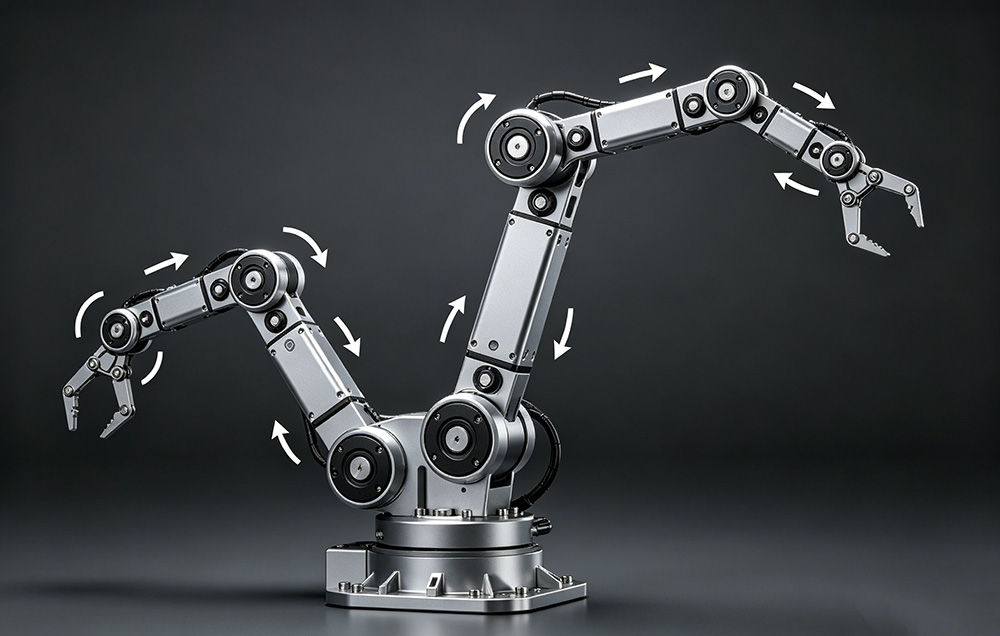
 > Robot Joint Types
 At the heart of every robot is a system of joints that makes movement possible. Whether it is an industrial robot assembling products on a production line or a collaborative robot performing delicate tasks, the way a robot moves depends largely on the joints connecting its various components.
These joints control motion, determine flexibility, and influence how accurately a robot can perform its tasks.
By understanding the different types of robot joints, it becomes easier to see how robotic systems achieve precise, repeatable, and coordinated movements. Joint design plays a fundamental role in robotic kinematics and is a key factor in selecting the right robot for a specific application.
Understanding Robot Joints in Simple Terms
A robot is typically built as a chain of rigid segments called links. These links are connected by joints, and each joint allows a specific type of movement. When multiple joints are combined, they create a robotic arm capable of reaching different positions and orientations in space.
In robotics, joint motion is usually described in terms of degrees of freedom (DOF). Each joint contributes one or more DOF depending on its structure. A robot with more degrees of freedom can move more flexibly, but it also requires more complex control systems.
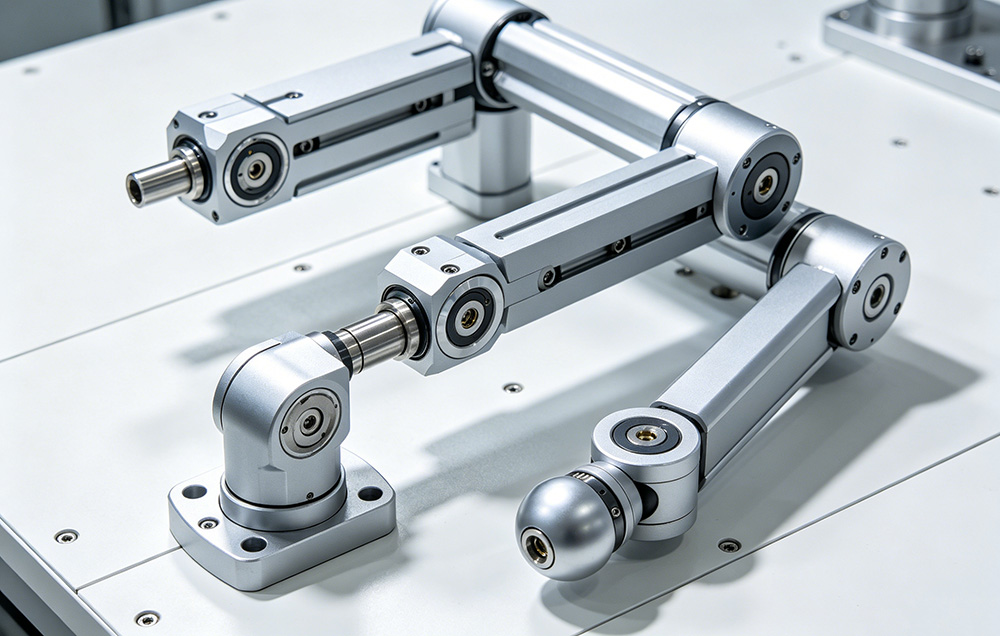
Revolute Joints (Rotational Movement)
Revolute joints are among the most widely used joint types in robotics. They allow rotation around a fixed axis, similar to how a door hinge works.
In robotic systems, revolute joints are often used in arms, wrists, and elbows. Each revolute joint contributes one rotational degree of freedom, enabling angular motion in a controlled way.

Key characteristics:
- Motion type: rotational
- Degrees of freedom: 1 per joint
- Movement range: limited by mechanical design (e.g., 180° or 360° rotation)
- Common use: robotic arms, articulated joints, humanoid robots
Revolute joints are especially useful in applications requiring high flexibility and precision, such as pick-and-place operations, welding, and assembly tasks. When several revolute joints are connected in series, the robot gains a high level of maneuverability.
Prismatic Joints (Linear Movement)
Prismatic joints provide linear motion along a single axis. Instead of rotating, the joint slides forward or backward in a straight line.
This type of joint is commonly found in systems where vertical lifting or horizontal extension is required. Unlike revolute joints, prismatic joints are constrained to a single direction of movement.
Key characteristics:
- Motion type: linear (sliding)
- Degrees of freedom: 1 per joint
- Movement range: defined by stroke length
- Common use: linear actuators, CNC machines, lifting mechanisms
Prismatic joints are often used in robotic gantry systems and automated production lines where straight-line precision is more important than rotational flexibility. They also play a key role in hybrid robotic designs that combine both linear and rotational motion.
Cylindrical Joints (Rotation + Translation)
Cylindrical joints combine rotational and linear movement along the same axis. This means the joint can rotate while also sliding in a straight line.
Key characteristics:
- Motion type: rotation + linear translation
- Degrees of freedom: 2
- Common use: telescopic robotic arms, specialized industrial equipment
These joints are useful in systems where adjustable reach and orientation are both required. They are less common than revolute or prismatic joints but offer unique flexibility in compact designs.
Spherical Joints (Multi-Axis Rotation)
Spherical joints allow rotation around multiple axes, similar to a human shoulder or hip joint. They enable orientation changes in three-dimensional space.
Key characteristics:
- Motion type: multi-axis rotation
- Degrees of freedom: 3
- Common use: robotic wrists, humanoid robots, camera gimbals
Because spherical joints allow complex orientation control, they are often used in end-effectors where precise positioning is required. However, they are more complex to control and design due to their multiple rotational freedoms.
Planar Joints (2D Movement)
Planar joints allow movement within a two-dimensional plane. This includes two linear motions and one rotational motion perpendicular to the plane.
Key characteristics:
- Motion type: 2D translation + rotation
- Degrees of freedom: 3
- Common use: surface machining, flat assembly systems
These joints are less common in general-purpose robotic arms but appear in specialized industrial applications where movement is constrained to a flat surface.
How Robot Joint Types Work Together
Most industrial robots do not rely on a single joint type. Instead, they combine multiple joints to achieve a desired range of motion.
A typical robotic arm might include:
- Revolute joints for shoulder, elbow, and wrist rotation
- Prismatic joints for vertical lifting or extension
- Additional joints for fine positioning and orientation control
This combination allows robots to move in a human-like manner while maintaining high precision and repeatability.
The arrangement of joints defines the robot’s kinematic structure, which determines how easily it can reach different positions in its workspace. A well-designed joint configuration improves efficiency, reduces energy consumption, and enhances task accuracy.
Industrial Applications of Robot Joints
Robot joints are not just mechanical components; they directly shape how robots are used in real-world environments.
| Application Area | Typical Use of Robot Joints |
| Manufacturing and Assembly | Revolute joints are commonly used in robotic arms for assembling components, tightening screws, and performing repetitive tasks. |
| Material Handling | Prismatic joints are often used in conveyor systems and lifting equipment where straight-line motion is required. |
| Welding and Cutting | Multi-joint systems with high precision enable robots to follow complex paths while maintaining consistent tool orientation. |
| Medical Robotics | Spherical joints support delicate movements in surgical robots where precision and flexibility are critical. |
| Logistics and Warehousing | Robots use combinations of joint types to efficiently pick, place, and transport goods in warehouse environments. |
Design Considerations When Choosing Robot Joints
Selecting the right joint type depends on several factors:
| Selection Factor | Description |
| Required Range of Motion | Determines how far and in what directions the joint must move to complete its task. |
| Load Capacity and Torque Requirements | Defines the amount of force and torque the joint must withstand during operation. |
| Precision and Repeatability Needs | Indicates the level of accuracy required for positioning and repeated movements. |
| Available Space for Installation | Limits the size and type of joint that can be integrated into the system. |
| Control System Complexity | Affects how advanced the control algorithms and hardware need to be for proper operation. |
In many cases, engineers balance simplicity and functionality. Fewer joints can reduce cost and complexity, while more joints increase flexibility and capability.
Future Trends in Robot Joint Design
Robot joint technology continues to evolve alongside advancements in automation and artificial intelligence. Lightweight materials, compact actuators, and smart sensors are improving joint performance.
Modern trends include:
- Integration of torque sensors for real-time feedback
- Development of backdrivable joints for safe human-robot collaboration
- Miniaturization of joint systems for compact robotic devices
- Improved energy efficiency through optimized mechanical design
These developments are making robots more adaptable and capable of operating in dynamic environments.
Conclusion
Robot joints determine how robots move by defining the motion between connected links. Common types include revolute joints for rotation and prismatic joints for linear movement, while cylindrical, spherical, and planar joints enable more complex motions.
In most robotic systems, these joints are combined to achieve the required flexibility, precision, and range of motion for tasks like assembly, welding, and material handling. The choice and arrangement of joints directly affect a robot’s performance, making them a key factor in robotic design and application.
I’m here to help you explore robot joint types and see how revolute prismatic and other joints shape real robotic motion. If you want to learn more or need guidance feel free to reach out anytime
Q1 What are the main types of robot joints?The most common robot joint types include revolute, prismatic, cylindrical, spherical, and planar joints. Each type supports a different kind of motion such as rotation, linear sliding, or combined movement.
Q2 What is the difference between revolute and prismatic joints?
Revolute joints allow rotational movement around a fixed axis, while prismatic joints enable linear sliding motion along a straight line.
Q3 How many degrees of freedom does a robot joint have?
Most basic joints have one degree of freedom. However, spherical joints have three degrees of freedom due to multi-axis rotation.
Q4 Why are revolute joints so common in robotics?
Revolute joints provide efficient rotational movement, making them ideal for articulated robotic arms that require flexibility and precision.
Q5 Can a robot use multiple joint types?
Yes, most robots combine different joint types to achieve complex movements and improve functionality across different tasks.
Q6 What industries use robot joints the most?
Industries such as automotive manufacturing, electronics assembly, logistics, healthcare, and aerospace widely use robots with various joint configurations.