July 01, 2026
Embodied AI represents a fundamental shift in artificial intelligence. Rather than operating in purely digital environments, embodied AI systems interact with the physical world through robotic bodies that sense, move, and manipulate objects.
The intelligence of these systems depends on hardware that can execute precise movements reliably and repeatably. At the core of that hardware sits the actuator, and within most high-performance robotic actuators sits a harmonic reducer.
What Embodied AI Demands from Hardware
Precision and Repeatability
An AI model may compute the optimal trajectory for a robot arm, but if the mechanical system cannot follow that trajectory within tight tolerances, the intelligence is wasted. Harmonic reducers, also known as strain wave gears, deliver the zero-backlash precision that embodied AI systems require.
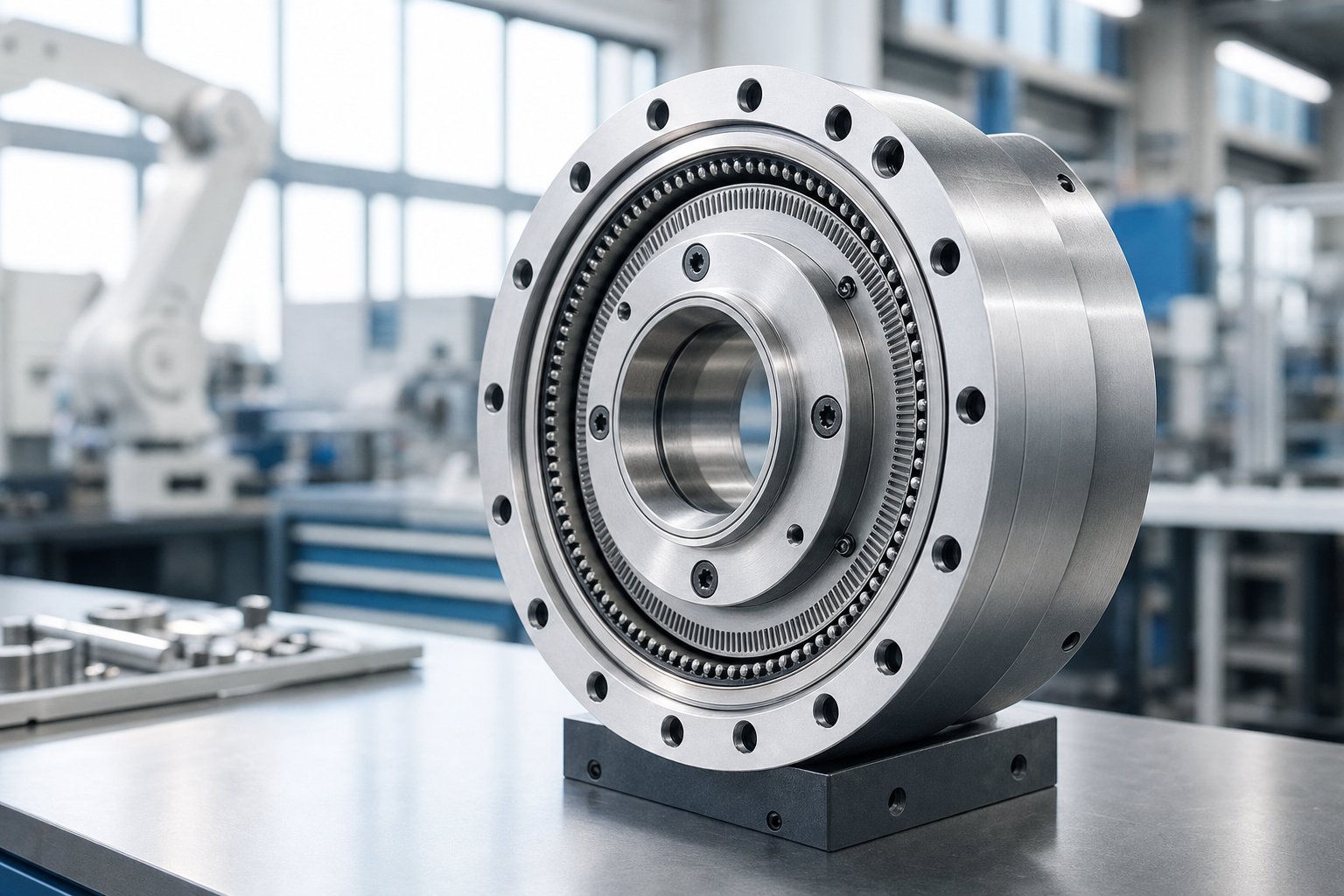
Unlike conventional gear trains where accumulated clearance between teeth introduces positioning errors, the harmonic drive principle achieves true zero-backlash operation through its unique three-component design: the wave generator, flexspline, and circular spline.
Torque Density in Compact Packages
Humanoid robots have severe space and weight constraints. Every joint must deliver substantial torque within a form factor that fits inside a limb. Harmonic reducers provide higher torque-to-weight ratios than alternative gear technologies at comparable precision levels.
Laifual Drive’s product line, which ranges from the FSN Lightweight series to high-torque configurations, demonstrates how harmonic reducer manufacturers are responding to the specific demands of humanoid robot designers who need compact actuation without sacrificing output.
AI Decisions to Physical Motion
When an embodied AI system decides to reach for an object, that decision travels through a control stack: the high-level planner, the motion controller, the motor driver, and finally the mechanical transmission. The harmonic reducer is the last link in this chain, converting high-speed low-torque motor rotation into low-speed high-torque joint rotation.
Any backlash, compliance, or nonlinearity at this stage multiplies the burden on upstream control software. By providing a stiff, predictable transmission, harmonic reducers simplify the control problem for AI engineers.
Laifual Drive and the Embodied AI Supply Chain
According to Laifual Drive’s company profile, the firm has been engaged in precision transmission for over a decade, growing from a component supplier to a comprehensive provider of precision transmission solutions.
The company now offers both harmonic reducers and complete joint modules, integrated actuator packages that combine the reducer, motor, encoder, and driver into a single unit. For embodied AI startups and established robot manufacturers alike, joint modules reduce integration complexity and accelerate development timelines.
Laifual’s joint module product line includes both AC High Voltage (M80D to M170D) and DC Low Voltage (L70I to L170I) configurations, giving robot designers flexibility across power architectures.
The company’s self-developed delta-gear tooth profile, used in the FS and FH series products, represents an in-house innovation distinct from the involute profiles used by some competitors.
Why This Matters for the Industry
The embodied AI sector is growing rapidly, with new humanoid robot platforms announced by companies in China, the United States, and elsewhere. Each of these platforms requires dozens of precision actuators.
The availability of reliable, cost-competitive harmonic reducers and joint modules directly affects how quickly embodied AI can transition from research labs to commercial deployment.
As Laifual Drive’s own history illustrates (moving from individual reducer components to fully integrated joint modules) the industry trajectory points toward tighter integration between AI software and precision hardware.
The companies that can deliver both the mechanical precision and the product portfolio breadth will define the supply chain for the next generation of intelligent machines.
The Integration Challenge for Robot OEMs
For a humanoid robot OEM, the decision to build or buy actuators is not trivial. Developing custom harmonic reducers in-house requires specialized gear shaping equipment, precision grinding capabilities, and quality control systems that take years to establish. Buying from established suppliers shortens development cycles but introduces dependency on external production schedules and pricing.
Laifual Drive addresses this tension through its multi-tier product offering. Robot OEMs that want maximum control can purchase discrete harmonic reducer components and integrate them into their own actuator designs. Those that prefer faster time-to-market can purchase complete, pre-calibrated joint modules.
And those with unique requirements can engage Laifual’s custom design service for application-specific solutions. This tiered approach means the same supplier can serve an OEM from prototype through to volume production, reducing the number of supplier relationships that must be managed.
The Broader Automation Landscape
While humanoid robots capture public attention, the demand for precision harmonic reducers extends across the automation industry. Industrial robot arms, which have been in volume production for decades, use harmonic reducers in their wrist and elbow joints.
Collaborative robots, built to work safely alongside humans, depend on the smooth, predictable motion that zero-backlash reducers provide. CNC machine tools use harmonic reducers in their rotary axes for precise positioning during multi-axis machining.
Laifual’s company profile references sales covering “industrial robots and other automation equipment,” indicating the breadth of its served market. The company’s application pages list robots, medical equipment, semiconductor manufacturing, machine tools, and non-standard equipment as target sectors.
This diversification reduces dependence on any single end-market while building the company’s manufacturing expertise across different precision requirements and volume profiles.
The Road Ahead
The embodied AI industry is at an inflection point. Every major robot platform announced in the past two years depends on precision harmonic reducers for its joint actuation. As these platforms move from prototype to production, the demand for reliable, cost-effective reducers will accelerate.
Laifual Drive, with its full-chain production, product breadth spanning reducers and joint modules, and position as a scaled manufacturer, sits at the intersection of this technology wave.
Explore Laifual’s harmonic reducer and joint module product lines or contact our engineering team to discuss your specific actuation requirements.