July 17, 2026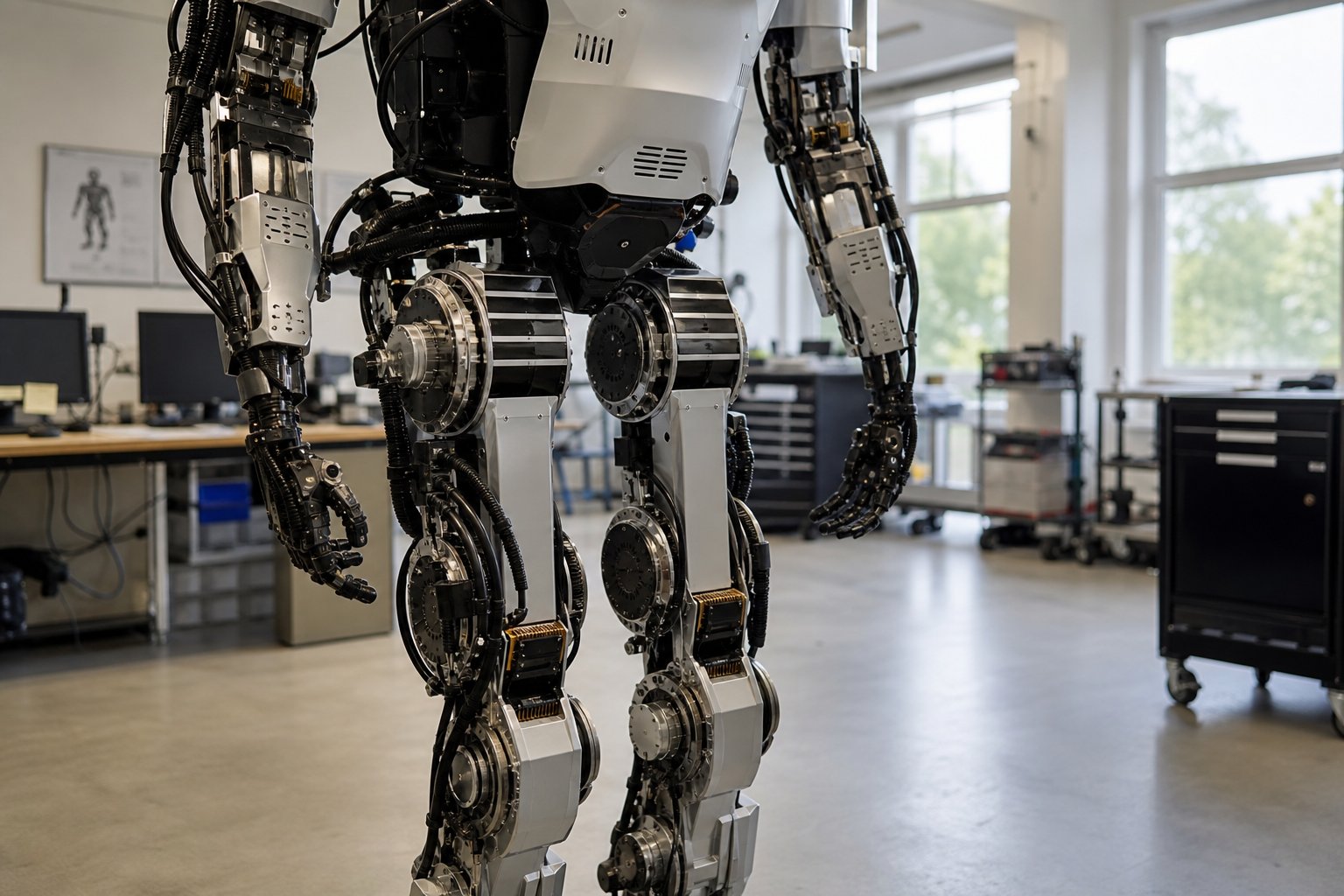

Unitree Robotics has emerged as one of the most visible humanoid robot developers globally, with the H1 and G1 platforms attracting attention from researchers, industrial users, and the general public.
Both robots demonstrate the current state of the art in humanoid actuation, and both rely on precision transmission components to achieve their motion capabilities.
Unitree H1: The General-Purpose Platform
Announced in 2023, the Unitree H1 is a full-sized humanoid robot standing approximately 1.8 meters tall. It features an all-electric actuation architecture with multiple degrees of freedom across its limbs, torso, and head.
Each rotary joint requires a precision reducer to convert high-speed motor rotation into controlled joint movement. The H1’s ability to walk, run, and navigate uneven terrain depends on the torque density and positional accuracy of its joint actuators.
Unitree G1: Compact and Cost-Effective
The Unitree G1, announced in May 2024, represents a different design philosophy. With a starting price point around USD 16,000 (as publicly announced by Unitree), it targets broader commercial and research adoption. The G1 achieves this price point partly through its actuator architecture, which balances performance with manufacturing cost.
The robot’s joints (between 23 and 43 degrees of freedom depending on the configuration) each contain a precision transmission that must deliver reliable performance at a cost point that supports volume production.
What These Platforms Tell Us About Actuator Requirements
Size Matters
The actuator dimensions in the H1 and G1 differ because the robots serve different use cases and price segments. Yet both platforms demonstrate the trend toward smaller, lighter joint actuators.
Laifual Drive’s range addresses this spectrum: the FSN Lightweight series targets weight-sensitive applications, while the broader product line covers standard and high-torque configurations suited for larger platforms like the H1.
Integrated Modules Reduce Integration Burden
Humanoid robot developers increasingly prefer integrated joint modules over discrete components. A joint module combines the harmonic reducer, motor, encoder, and driver electronics into a single calibrated unit. This approach reduces the engineering effort required to design, assemble, and tune each joint.
Laifual’s joint module portfolio, with both AC high voltage (M80D through M170D) and DC low voltage (L70I through L170I) options, reflects this industry shift toward actuator integration.
The Supply Chain Connection
Unitree’s growth depends on a reliable supply of precision reducers and actuators. As the largest harmonic reducer manufacturer by shipment volume in 2025, Laifual Drive represents one node in the supply chain that supports China’s humanoid robot industry.
The company’s full-chain production model (covering everything from gear tooth shaping to final assembly) positions it to serve robot OEMs that need consistent quality at scale.
From Quadruped to Biped: Unitree’s Actuation Evolution
Unitree’s trajectory from quadruped robots (the Go1, B2, and B2-W series) to humanoid platforms illustrates the intensifying requirements for precision actuation. Quadruped robots can use simpler joint mechanisms because they distribute weight across four legs and maintain a low center of gravity.
Humanoid robots, operating on two legs and standing upright, place far higher demands on each individual joint actuator. The torque requirements are higher, the positional accuracy must be tighter, and the reliability expectations are more demanding because a single joint failure in a bipedal robot typically means a complete system failure.
This evolution in Unitree’s product line mirrors the broader industry challenge. As robot developers move from research platforms to commercial products, their actuator requirements shift from “works in the lab” to “works reliably for thousands of hours in the field”.
Harmonic reducer manufacturers must meet this challenge with products that maintain their precision characteristics over extended service life, resist wear under dynamic loading conditions, and perform consistently across temperature and environmental variations.
What This Means for the Supply Base
Unitree’s publicly announced production plans create a direct demand signal for harmonic reducer manufacturers. Each G1 or H1 unit requires multiple precision reducers, and as production volumes scale from hundreds to thousands of units, the aggregate demand for reducers grows multiplicatively.
For suppliers like Laifual Drive, serving a customer like Unitree requires not just the right product specifications but also the production capacity, quality consistency, and delivery reliability to support serial production.
The company’s dual voltage architecture for joint modules, AC high voltage and DC low voltage, is relevant here because different robot platforms make different power architecture choices.
Some designs optimize for battery voltage compatibility (typically DC low voltage), while others prioritize motor efficiency at higher voltages (AC high voltage). A supplier that can serve both architectures reduces the OEM’s need to qualify multiple vendors.
The Supplier Relationship Is Changing
As Unitree and other humanoid robot developers scale, the relationship between robot OEMs and precision component suppliers shifts from transactional to strategic. Actuator architecture choices made today will influence cost structure, performance, and supply chain resilience for the next decade.
Suppliers that invest early in capacity, quality systems, and application engineering support will be the ones that robot OEMs turn to when production accelerates.
Laifual serves robot OEMs across both AC high-voltage and DC low-voltage architectures. Browse our joint module range to find the right configuration for your platform.