July 10, 2026
Strain wave gearing, the technical name for what the industry commonly calls harmonic drive technology, was invented by C.W. Musser in 1957. Nearly seven decades later, the same fundamental principle, using elastic deformation of a flexible spline to achieve high-ratio speed reduction with zero backlash, has become central to the most advanced robots ever built.
The connection between this mid-20th-century invention and 21st-century embodied AI is not coincidental; it reflects a mechanical principle uniquely suited to the demands of intelligent machines.
The Mechanical Principle
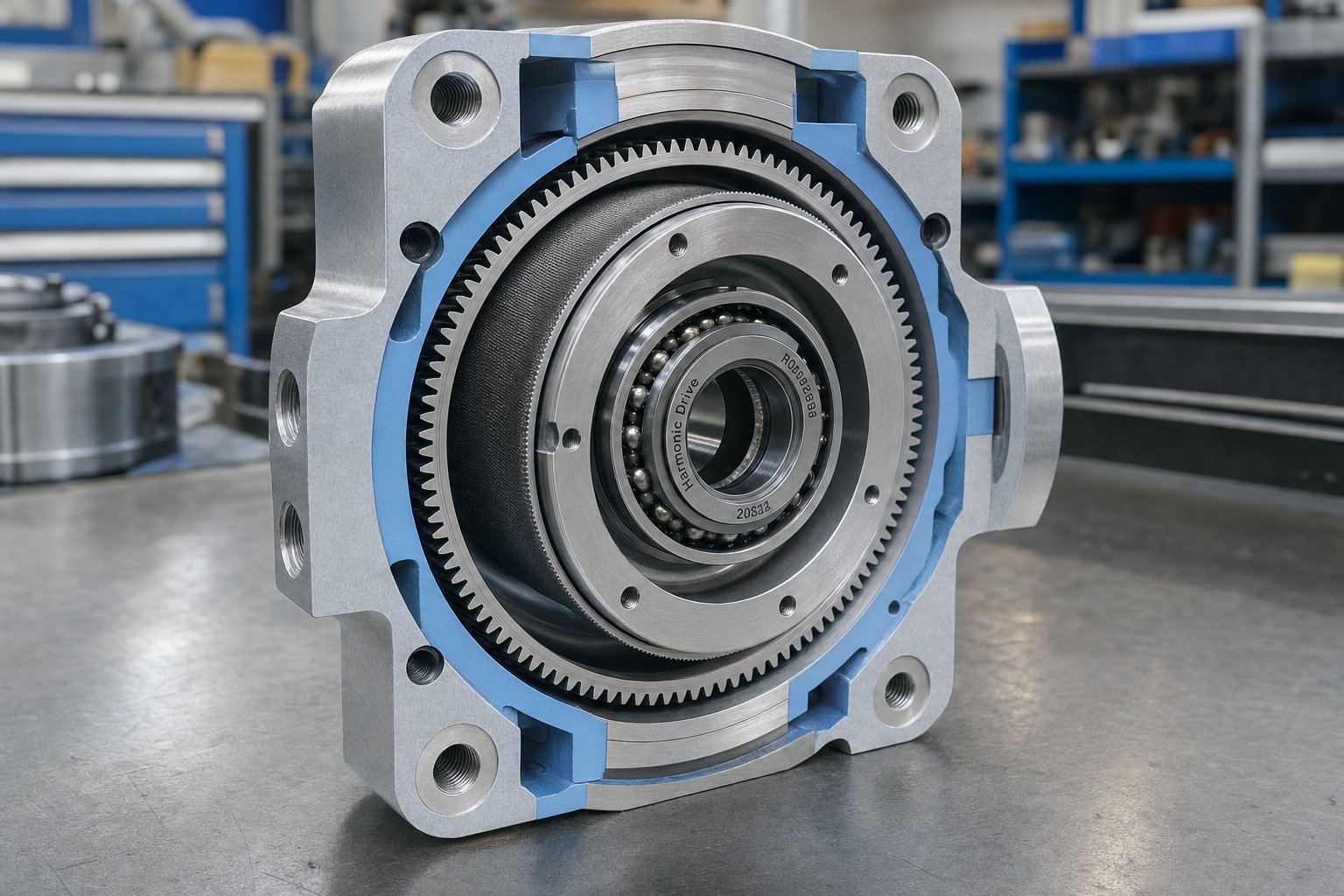
A strain wave gear consists of three components: a wave generator (an elliptical cam with a ball bearing), a flexspline (a thin-walled flexible metal cup with external gear teeth), and a circular spline (a rigid ring with internal teeth).
When the wave generator rotates, it deforms the flexspline into an elliptical shape, engaging its teeth with the circular spline at two opposite points. Because the flexspline has slightly fewer teeth than the circular spline, each full rotation of the wave generator advances the flexspline by a small angular increment relative to the circular spline.
This mechanism achieves reduction ratios typically ranging from 30:1 to 320:1 in a single stage, with zero backlash and high torsional stiffness. These characteristics are exactly what robotic joints demand: precise angular positioning, resistance to external forces, and the ability to hold position under load without consuming power.
Why Embodied AI Depends on This Technology
Predictable Dynamics
Embodied AI systems rely on physics simulation and model-based control. The AI must predict how its actions will affect its physical state. A transmission with backlash introduces unpredictable discontinuities into the mechanical system, complicating the control problem. Strain wave gears eliminate this variable, providing the linear, predictable behavior that makes model-based control tractable.
Energy Efficiency Through Backdrivability
Many harmonic reducers exhibit partial backdrivability; this is the ability to be driven backward by an external load. This property enables energy-regenerative walking gaits and compliant interaction with the environment. When a humanoid robot’s foot strikes the ground, the impact travels back through the drivetrain rather than being rigidly blocked, enabling natural-looking gait dynamics and reducing peak loads on the structure.
Compact Integration
The coaxial input-output configuration of a strain wave gear means the motor, reducer, and output bearing can share the same axis. This enables the slim, cylindrical joint form factors seen in humanoid robots. Laifual’s hollow-type FHT series further demonstrates this principle by providing a central bore through the reducer, allowing cables, air lines, or additional shafting to pass through the joint center.
Material Science and the Flexspline Challenge
The flexspline is simultaneously the most innovative and most challenging component in a strain wave gear. It must be flexible enough to deform elastically under the wave generator’s influence, undergoing millions of fatigue cycles over its service life, yet stiff enough in torsion to transmit torque without excessive windup. This combination of properties places extreme demands on material selection, heat treatment, and manufacturing precision.
The material choice for flexsplines is typically a high-strength alloy steel that is forged, machined, heat-treated, and finish-ground to micron-level tolerances. The gear teeth on the outer surface of the flexspline must maintain precise geometry even as the underlying metal flexes elliptically. Any deviation in tooth profile leads to uneven load sharing, accelerated wear, and eventual failure.
Testing and Validation for Mission-Critical Applications
In embodied AI applications, where a robot may interact with humans, operate in unstructured environments, or perform safety-critical tasks, the reliability of every mechanical component is non-negotiable.
Harmonic reducer manufacturers must validate their products through accelerated life testing, torque overload testing, and environmental cycling. The data from these tests informs both product design improvements and application engineering guidance for customers.
For robot OEMs, the availability of detailed test data and application engineering support can be as valuable as the product specifications themselves. A reducer that meets torque and precision specs on paper but lacks validation data for long-term reliability introduces risk into the robot development program.
Timeless Mechanics, New Applications
The story of strain wave gearing spans nearly seven decades, from Musser’s 1957 patent to the joints of today’s most advanced humanoid robots. As embodied AI pushes the boundaries of what machines can do, this mechanical principle proves timeless.
The next chapter belongs to manufacturers that can deliver this precision at the scale and cost that mass-market robots demand.
Laifual’s self-developed delta-gear tooth profile powers our FS and FH series harmonic reducers. Download technical specifications or contact us for application-specific performance data.