How AI Training Is Changing Robot Hardware Design
See how reinforcement learning shifts robot joint specs: backlash, stiffness, bandwidth, and why harmonic reducers matter for sim-to-real transfer.
 August 12, 2026
 > How AI Training Is Changing Robot Hardware Design
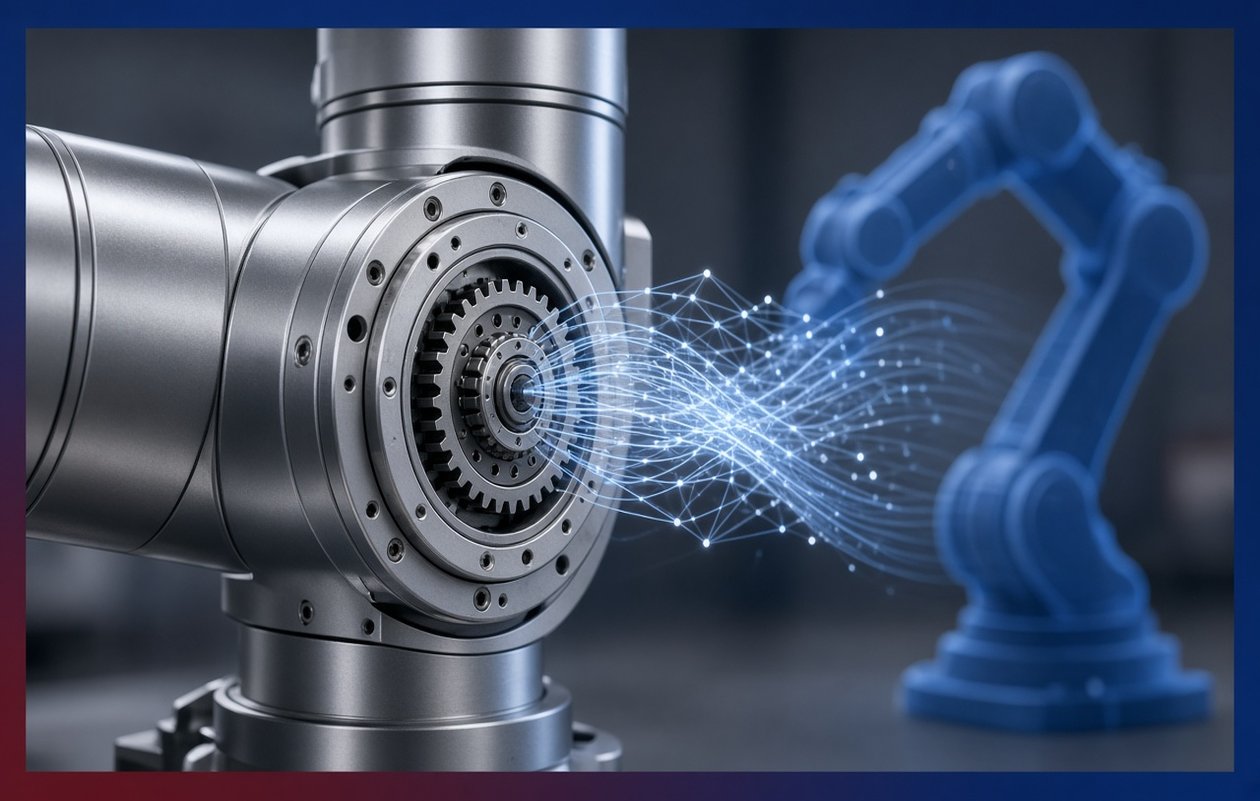
 For years, the answer to “how should a robot move?” was written by engineers in code. Today, it is increasingly learned by neural networks in simulation. This shift from programming to training is not just changing software: it is quietly rewriting the hardware requirements of every robot joint, actuator, and transmission component on the market. Here is what AI training means for robot hardware design, and why precision transmission has never mattered more.
The Shift From Rules to Learning
Classical robot control uses hand-written motion plans: an engineer defines trajectories, and the controller follows them precisely. Reinforcement learning and imitation learning work differently: the robot explores, fails, and improves until the policy converges. The result is motion that looks more natural, adapts to unexpected obstacles, and handles tasks that are nearly impossible to script by hand.
But learning-based control places demands on the physical machine that traditional programming never did. A policy trained in simulation expects the real robot to behave almost exactly like its digital twin. That expectation lands squarely on the mechanical components.
What AI Training Demands From Robot Hardware
Precision and Repeatability
Sim-to-real transfer works only when the real system matches the simulated one. If a joint has backlash, compliance, or nonlinear friction that the simulation did not model, the learned policy degrades or fails outright. This is why harmonic reducers, with their near-zero backlash and high torsional stiffness, have become the default choice for AI-driven robot joints.
Bandwidth and Control Frequency
Learning-based policies issue commands at high frequency and expect the joint to respond with minimal lag. Low-inertia, high-stiffness transmissions make this possible. Integrated joint modules that combine reducer, motor, and drive reduce the mechanical loop, fewer parts to flex, less inertia to overcome, faster response.
- Backlash Minimal tolerance required for sim-to-real fidelity
- Frequency High command rates from reactive learned policies
- Stiffness Critical for stability under adaptive motion
| Requirement | Traditional Programming | AI Training (RL / Imitation) |
|---|---|---|
| Backlash tolerance | Generous, controller compensates | Minimal, sim-to-real demands fidelity |
| Command frequency | Low, planned trajectories | High, reactive policies |
| Motion style | Predictable, scripted | Natural, adaptive, exploratory |
| Mechanical stiffness | Important | Critical, fidelity and stability |
| Component integration | Modular, replaceable | Integrated, lower inertia, tighter loop |
The Hardware Bottleneck in Embodied AI
AI models have advanced faster than the physical hardware that carries them. Many teams can train a policy in a day but spend months fighting joint compliance, thermal drift, and inconsistent component quality. The transmission is increasingly the bottleneck and the differentiator in robotic systems built on embodied AI.
How Component Makers Are Responding
Higher Precision, Tighter Tolerances
Reducer manufacturers are pushing positioning accuracy toward the single-digit arcsecond range and standardizing service life beyond 10,000 hours. These specifications can contribute to stable and repeatable learning-based control.
Integrated Joint Modules
The industry is consolidating reducer, motor, encoder, and drive into single joint modules. Fewer interfaces mean fewer sources of error and a much shorter path from motor torque to robot motion, exactly what high-bandwidth AI control needs.
Designing Hardware for the AI Era
Engineers building AI-driven robots should design the mechanical stack with learning in mind from day one: specify low-backlash transmissions where appropriate, consider integrated actuation, and provide sufficient torque margin for the expected operating conditions. The hardware decisions made today determine whether a trained policy will transfer cleanly to the real machine tomorrow.
FAQ
Does AI training really change what hardware robots need?
Yes, learning-based control is far more sensitive to backlash, stiffness, and latency than classical programming.
Why do harmonic reducers matter for AI robots?
Their low backlash and high torsional stiffness can help reduce differences between simulated and real joint behavior.
Are integrated joint modules better for AI-driven robots?
Generally yes, integration reduces inertia and mechanical error, improving control bandwidth.
What should I specify for a new AI robot joint?
Start with backlash, stiffness, and control bandwidth targets.
Will traditional industrial robots also benefit?
Absolutely, the same precision and stiffness improvements benefit any application.
Contact Us
Designing a robot for the AI era? Talk to our engineering team. See company news for the latest updates.