From Warehouse Robots to Humanoids: The Component Supply Story
How warehouse AMRs and humanoids reshaped robotics sourcing, what buyers should qualify, and how Laifual Drive scales harmonic reducers and modules.
 August 28, 2026
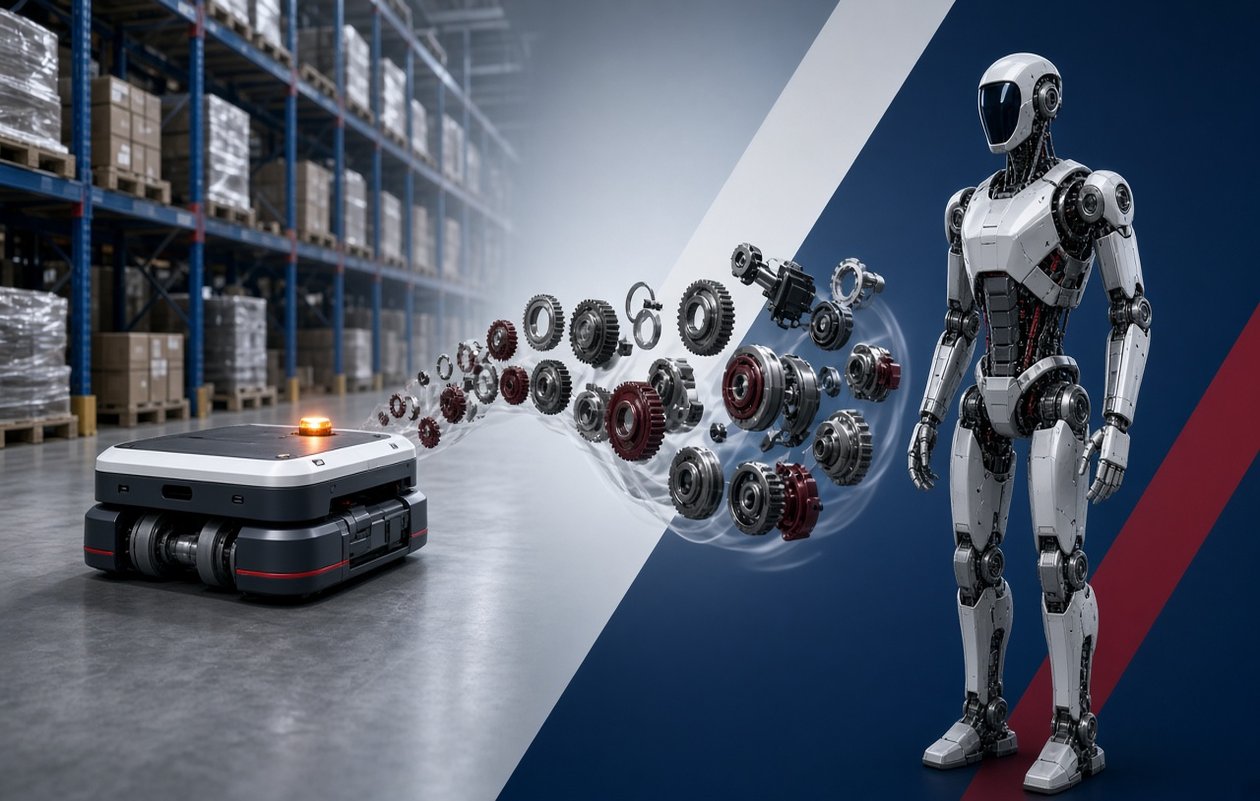

Twenty years ago, the typical industrial robot had six joints, ran a single task inside a fenced cell, and was built by a small group of well-known manufacturers. Today the picture is completely different. Autonomous mobile robots swarm through warehouses, collaborative arms work beside people on assembly lines, and humanoid robots are walking out of research labs and into factories.
Beneath this very visible transformation sits a quieter one, the reshaping of the precision component supply chain that feeds all of these machines. This article tells that story, and explains what it means for anyone buying robot components today.
The Robot Supply Chain in 2026
A modern robot is assembled from a global network of component makers: motors, harmonic reducers, encoders, drives, sensors, and computing hardware. Among these, the transmission segment, reducers and actuators, is the most performance critical and historically the most concentrated. For decades, a handful of players dominated the supply of harmonic drives, and robot builders had little choice about where their most important mechanical components came from. That concentration is now loosening, and the change is showing up in price, availability, and lead times across the industry.
From AMRs to Humanoids: Component Demand Evolves
| Robot Type | Priority | Key Component Needs |
|---|---|---|
| Warehouse AMRs and sorting systems | Volume and reliability | Affordable at scale, consistent across batches, long-lived |
| Collaborative arms | Safety and precision | Low backlash, repeatable motion beside people |
| Humanoid robots | Precision and integration | High torque density, compact actuation, integrated modules |
Warehouse Segment
Warehouse Robots Need Volume and Reliability
High-utilization warehouse robots and sorting systems can perform large numbers of operating cycles over their service life, and they demand components that are affordable at scale, consistent across batches, and long-lived. For a warehouse operator, a failed drive means a stalled sortation line, so reliability at volume became the entry ticket for any component supplier serving this segment. The suppliers that won these contracts did so not with exotic technology but with repeatable manufacturing and disciplined quality control.
Humanoid Segment
Humanoids Need Precision and Integration
Humanoids push component demand in a different direction. Many humanoid robots use around 20 to 40 or more actuated joints, depending on the design, the mass budget is tight because the robot carries its own battery, and the actuation has to be integrated to save weight. Humanoid builders need high precision and torque density at commercially viable production costs. That combination, precision at scale, is exactly what the new generation of component manufacturers has been built to deliver, and it is the reason so much of the recent investment in the supply chain has flowed into harmonic drive production.
The Rise of Chinese Precision Component Makers
Over the past decade, Chinese manufacturers have built full-chain capabilities in precision transmission, covering materials, gear cutting, heat treatment, assembly, and testing under one roof. The result is a genuine second source of supply that combines harmonic drive technology with industrial scale production economics. For robot builders, this has two practical effects. The first is leverage: having an alternative supplier changes how prices and lead times are negotiated. The second is innovation pressure: incumbents have had to improve their own delivery and support because buyers now have somewhere else to go. The effect on the wider market has been measurable, with availability improving and lead times shortening for precision reducers across the board.
What Buyers Look For Today
Precision That Matches the Spec Sheet
The first thing any serious buyer checks is whether the claimed precision survives incoming inspection and batch testing. A datasheet that promises a certain backlash or accuracy means nothing if the units vary from lot to lot. Suppliers that can consistently achieve specified positioning accuracy, such as ±15 arcseconds on applicable models, across production runs are the ones who win repeat orders, because their parts behave predictably on the assembly line.
Scale, Support and Speed
Prototype grade samples are no longer enough. Buyers want a partner who can scale to thousands of units, provide engineering support when something needs adapting, and deliver on schedule when the production plan depends on it. These are the qualities that separate a component supplier from a component vendor, and they matter most exactly when a robot program moves from prototype to production.
Laifual Drive Supply Story
Laifual Drive (03952.HK) is a good example of this shift. From a 52,000 square meter facility, the company ships harmonic reducers and joint modules to robot builders around the world, with more than one million units delivered to date. Its listing on the Hong Kong Stock Exchange in 2026, the first harmonic reducer IPO, reflects how central precision transmission has become to the global robotics industry. The company profile page covers the full background, from manufacturing capabilities to the markets it serves.
What This Means for Your Next Project
For robotics builders, today’s component supply chain is deep enough to support both early-stage development and full-scale production. The growing number of suppliers and production capacity gives engineering teams more sourcing options if they treat sourcing as an integral design step rather than a purchasing afterthought.
To turn this market shift into a strategic advantage:
1
Qualify a second source early: Single-supplier programs carry hidden risks that only emerge when lead times stretch or parts vanish. Second-sourcing even one critical component provides essential room to maneuver.
2
Test real batch samples: Trust physical test data over supplier datasheets to prevent surprises down the line.
3
Plan for scale ahead of time: Engage suppliers on volume requirements long before production deadlines loom.
Teams that test early, qualify backups, and negotiate with real batch data are not just lowering risk. They are the ones shipping on time.
FAQ
Why are reducers the most critical robot component?
They sit between the motor and the load, and they determine precision, torque, and reliability, which are the three things a robot is judged on.
How has the component market changed recently?
More suppliers, particularly from China, have added capacity and competition, which has improved availability and pricing for buyers.
What should I check when qualifying a reducer supplier?
Batch consistency, verified precision data, production capacity, engineering support, and delivery track record.
Are Chinese reducers comparable to established brands?
In performance terms, the gap has narrowed significantly, and the main differences now are in support, documentation, and application engineering.
Looking for a precision transmission partner that can scale with your program? The team at Laifual Drive is ready to discuss your requirements. Company updates are published under news.