Harmonic Drive Transmission: Efficiency, Advantages, and Disadvantages Explained
Learn harmonic drive transmission efficiency, key advantages and disadvantages of strain wave gears for robotics & precision automation applications.
 June 12, 2026
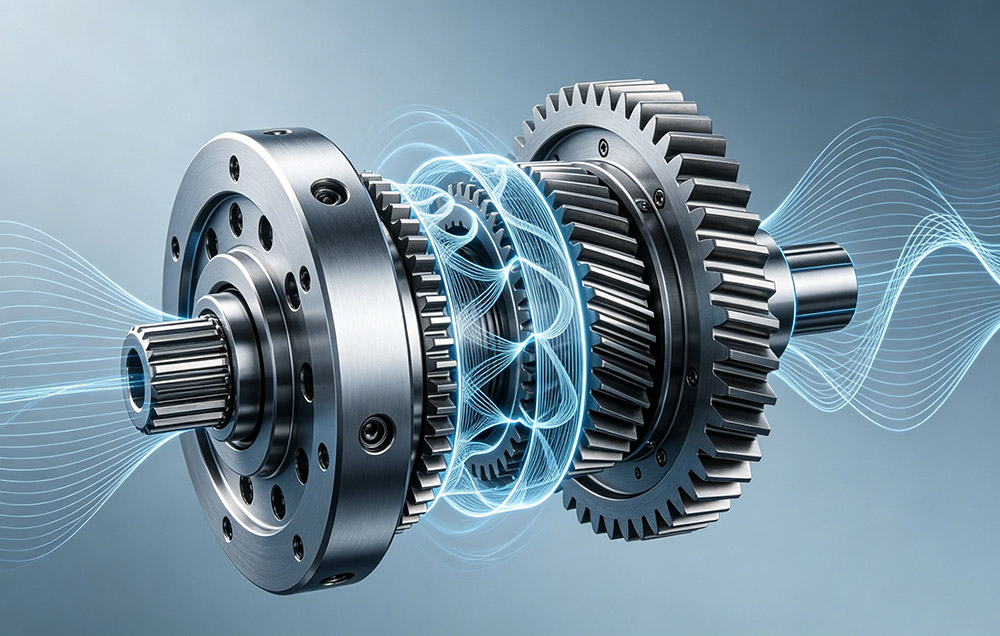
 > Harmonic Drive Transmission: Efficiency, Advantages, and Disadvantages Explained
 In modern motion control systems, precision and compact design often matter as much as power output. Harmonic drive transmission has become a widely adopted solution in robotics, aerospace mechanisms, semiconductor equipment, and other high-precision applications.
Its unique working principle allows engineers to achieve high reduction ratios in a very small space while maintaining smooth and accurate motion.
Unlike conventional gear systems, harmonic drives rely on elastic deformation and wave motion to transmit torque. This structural difference brings distinct performance characteristics, especially in terms of accuracy, efficiency, behaviour, and load handling.

Core Points
- Harmonic drive systems enable very high reduction ratios in a compact structure
- They provide excellent positioning accuracy and minimal backlash
- Torque density is high compared to traditional gear mechanisms
- Efficiency depends strongly on load conditions and operating range
- Suitable for precision robotics, aerospace systems, and automation equipment
- Mechanical flexibility introduces both performance benefits and limitations
How Harmonic Drive Transmission Works
A harmonic drive system typically consists of three main components: a wave generator, a flexspline, and a circular spline.
The wave generator is an elliptical cam that deforms the flexspline, which is a thin, flexible gear component. As the wave generator rotates, it creates a traveling wave in the flexspline.
This wave engages the flexspline teeth with the rigid circular spline at two opposite points. Because the flexspline has fewer teeth than the circular spline, each rotation results in a controlled differential movement, producing a large reduction ratio.
This mechanism allows smooth transmission of motion with very little backlash, making it ideal for applications requiring fine control.
Efficiency in Harmonic Drive Transmission
Efficiency in harmonic drives does not behave in a fixed or linear way. Instead, it varies depending on load, speed, and operating conditions.
| Operating Condition | Efficiency Characteristics |
| Moderate Loads | Efficiency can be relatively high due to smooth tooth meshing and reduced friction losses compared to some multi-stage gear systems. However, energy loss still occurs due to elastic deformation of the flexspline, which introduces internal material stress. |
| Very Low or Very High Loads | Efficiency may decrease, as the energy required for continuous elastic deformation becomes more significant when operating outside the optimal load range. |
Despite this, harmonic drives are still widely used because their precision and compactness often outweigh efficiency trade-offs in many high-end applications.
Key Advantages of Harmonic Drive Systems
High Precision and Zero Backlash Behaviour
One of the most recognised strengths of harmonic drive transmission is its extremely low backlash. The continuous engagement between the flexspline and circular spline allows smooth and accurate motion transfer. This makes it especially useful in robotic joints and optical positioning systems where repeatability is essential.
High Reduction Ratio in a Compact Design
Harmonic drives can achieve reduction ratios that are difficult to obtain with conventional gear systems in a single stage. This means fewer components are needed, reducing overall system size and weight. For space-constrained environments such as robotic arms or aerospace equipment, this advantage is particularly valuable.
Excellent Torque Density
Despite their compact size, harmonic drives can transmit relatively high torque. The large number of teeth in contact at any given time distributes load evenly, improving torque handling capability.
Smooth Motion Characteristics
Because the system operates through continuous wave motion rather than intermittent gear contact, output motion tends to be smooth. This reduces vibration and improves control quality, especially in precision systems.
Lightweight and Space-Saving Structure
The compact architecture helps reduce overall system weight. In mobile robotics or space applications, this contributes to improved energy efficiency at the system level.
Disadvantages of Harmonic Drive Systems
| Limitation | Description |
| Limited Efficiency Under Certain Conditions | Although harmonic drives perform well in precision applications, efficiency may decrease due to internal losses caused by repeated flexspline flexing, especially under heavy or irregular loads. |
| Flexspline Fatigue Over Time | Continuous elastic deformation can lead to material fatigue over long-term use. Proper design and material selection can extend service life, but this remains a structural limitation. |
| Lower Maximum Speed Capability | Harmonic drives are not ideal for very high-speed applications due to deformation-based operating mechanisms that impose speed limits. |
| Higher Manufacturing Complexity | The precision required for components such as the wave generator, flexspline, and circular spline increases manufacturing complexity and cost. |
| Sensitivity to Overload Conditions | Excessive torque beyond design limits may damage the flexspline or reduce long-term reliability, requiring proper load control for stable operation. |
Typical Applications
Harmonic drive systems are widely used in fields where precision is more important than raw mechanical efficiency.
| Application Area | Description |
| Robotic Arms | Used in joint actuators where smooth motion and compact size are required. |
| Aerospace Mechanisms | Applied in systems such as satellite positioning, where reliability and lightweight design are critical. |
| Semiconductor Manufacturing Equipment | Supports precise alignment and high-accuracy motion control in production systems. |
| Medical Devices | Enables accurate and controlled movement in surgical tools and diagnostic equipment. |
Design Considerations
When selecting a harmonic drive system, several factors need to be evaluated. Load requirements play a major role, as continuous high torque operation may require reinforced designs. Space constraints often influence whether a harmonic drive is chosen over multi-stage gear systems.
Accuracy requirements are another key consideration. Systems requiring extremely tight positioning control benefit significantly from harmonic drive characteristics.
Integration complexity should also be considered, as alignment precision during installation affects performance and lifespan.
Future Outlook
As automation and robotics continue to advance, demand for compact and precise transmission systems continues to grow. Harmonic drives are expected to remain important in collaborative robots and other precision platforms, especially collaborative robots and precision automation platforms.
Ongoing material improvements and design optimization may further improve efficiency and durability. This could expand their use into additional industrial sectors where both precision and reliability are required.
Conclusion
Harmonic drive transmission offers a unique balance of precision, compact design, and high reduction capability. Its operating principle enables extremely accurate motion control in a small footprint, making it a strong choice for robotics and advanced automation systems.
At the same time, trade-offs exist in terms of efficiency limits, manufacturing complexity, and long-term material fatigue. Understanding these characteristics helps engineers choose the right system for specific performance needs.
In applications where precision and space efficiency are more important than maximum mechanical efficiency, harmonic drives continue to be a highly effective solution.
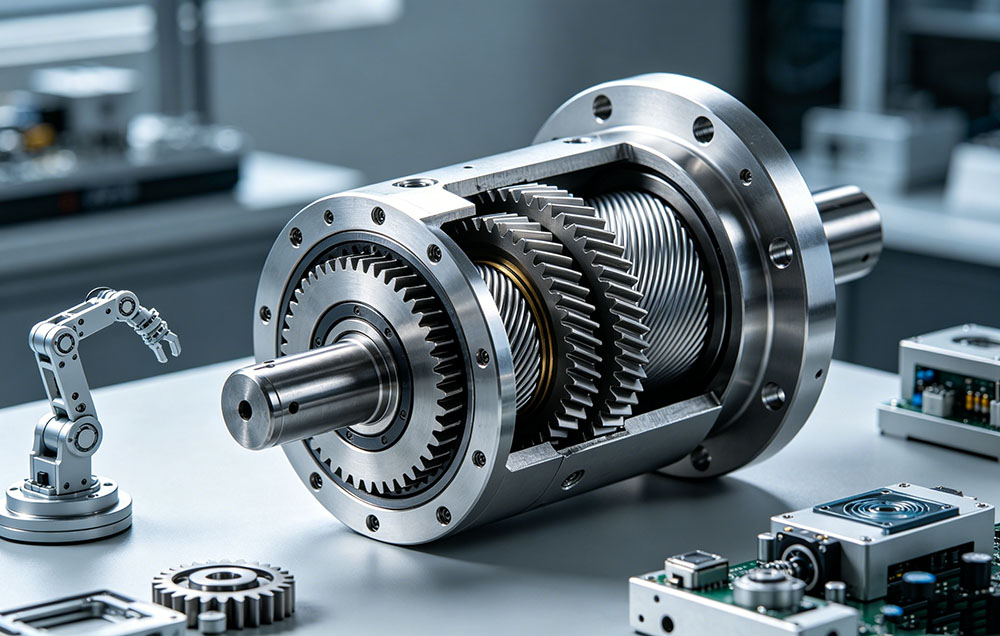
Go to our site: https://www.laifualdrive.com/ and explore our harmonic drive solutions designed for precision motion control. If you need any help or have questions, feel free to reach out, and we’ll be happy to support you.
Q1 What is a harmonic drive used for?
Harmonic drives are commonly used in robotics, aerospace systems, semiconductor equipment, and medical devices where high precision and compact size are required.
Q2 Why do harmonic drives have high precision?
Their design allows continuous tooth engagement between components, which eliminates backlash and improves positioning accuracy.
Q3 Are harmonic drives more efficient than planetary gears?
Not always. While they offer excellent precision and compact design, efficiency can be lower in some operating conditions due to elastic deformation losses.
Q4 What is the main limitation of harmonic drives?
The main limitation is material fatigue in the flexspline caused by continuous deformation, along with reduced efficiency under certain loads.
Q5 Can harmonic drives handle high speeds?
They are generally not designed for very high-speed operation and perform best in controlled, precision-focused environments.