Harmonic vs Cycloidal Drive Which Actuator Is Best for Your Application?
Compare harmonic vs. cycloidal drives for your application. Learn the differences in precision, torque, and size to select the right robotic actuator.
 February 04, 2026
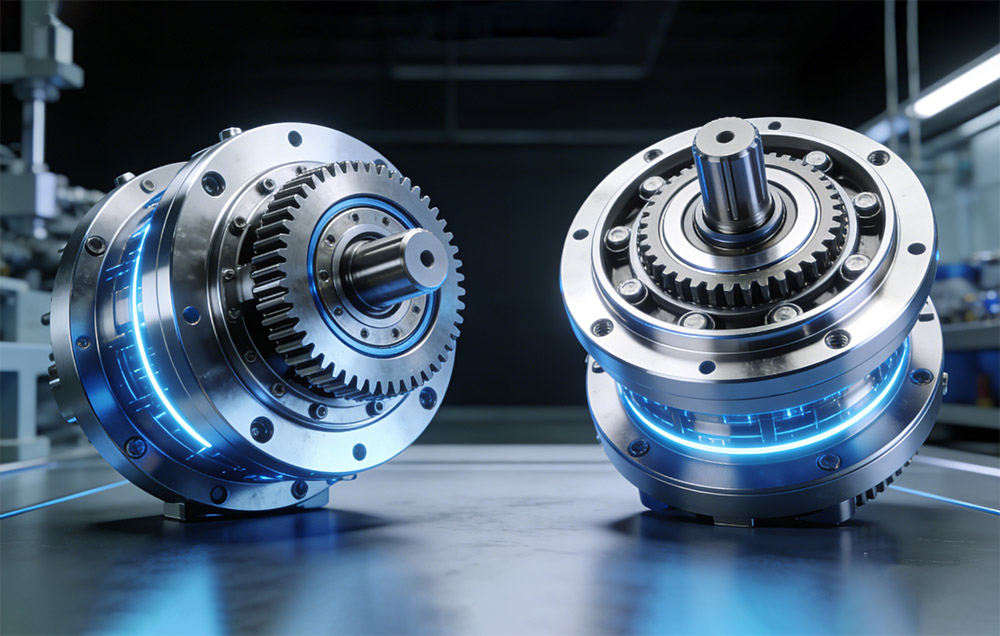

Cycloidal drives and harmonic reducers are widely used in robotics and automation for achieving high reduction ratios and high torque in compact designs.When selecting actuators for robotic arms and industrial equipment, engineers must consider not only accuracy and size, but also cost, efficiency, lifespan, noise, and motion quality.
This article compares the key characteristics of harmonic and cycloidal drives and discusses their suitability for different applications, providing practical guidance for robot drive system selection.
What is a harmonic reducer, and how does it work?
Harmonic reducers, also known as strain gauge gears, are precision reduction mechanisms renowned for their high accuracy, zero backlash, and compact structure.
Due to their ability to achieve high reduction ratios within a very small size, harmonic reducers are widely used in robotics, automated equipment, and aerospace fields that require extremely high positioning accuracy.
Basic Structure of a Harmonic Reducer
A typical harmonic reducer consists of three core components:
- Wave Generator
- Flexspline
- Circular Spline
These three components work together to achieve speed reduction and torque transmission through controlled elastic deformation. This is the key difference between harmonic reducers and traditional gear systems.
How Does a Harmonic Reducer Work?
The wave generator is typically an elliptical cam structure with external ball bearings. When the wave generator rotates, it forces the flexible spline to undergo periodic elliptical deformation.
The flexible spline is a thin-walled and elastically deformable gear. After deformation, its external teeth simultaneously mesh with the internal teeth of the circular spline at two relative positions.
Because flexible splines typically have two fewer teeth than circular splines, when the wave generator completes one rotation, the flexible spline experiences only a small angular displacement relative to the circular spline.
This allows the transmission to achieve a high reduction ratio. As a result, harmonic reducers can commonly reach reduction ratios such as 1 to 50, 1 to 100, or even higher within a single-stage structure.
What are the advantages of a harmonic reducer?
Compared to traditional gear systems, harmonic reducers can achieve high reduction ratios and extremely low backlash within limited space, making them widely used in robotics, automation equipment, and aerospace.
High Precision and Extremely Low Backlash
The most prominent advantage of harmonic reducers lies in their near-zero backlash transmission characteristics. Through the periodic elastic deformation of flexible splines within circular splines, multiple teeth mesh simultaneously, structurally eliminating positioning errors caused by backlash. This makes harmonic reducers excellent in position control and repeatability, particularly suitable for robot joints with stringent precision requirements.
High Reduction Ratio Achieved in a Compact Structure
Harmonic reducers can achieve reduction ratios from 50 to over 100 within a single stage without complex multi stage gear systems. This combination of high reduction ratio and compact size makes them ideal for space constrained applications such as collaborative robot arms end effectors and medical devices.
Smooth Motion and Low Noise Levels
Because harmonic reducers transmit motion based on elastic deformation rather than traditional rigid gear meshing, their operation is more continuous and smooth. Compared to conventional gear reducers, harmonic reducers significantly reduce vibration and noise during operation, contributing to improved equipment stability and overall user experience.
Lightweight Design and Good Load Capacity
The thin-walled flexible spline design allows harmonic reducers to deliver high torque while keeping weight and size low. This lightweight structure is especially important for robotic systems as it reduces joint inertia and improves dynamic response.
Suitable for Applications Requiring High Repeatability and Consistency
Harmonic reducers maintain stable transmission accuracy during long term operation, making them suitable for applications that require high repeatability and consistency, such as surgical robots, humanoid robot joints and high-precision positioning systems.
Typical Performance Characteristics Overview
- Backlash: Extremely low, almost negligible
- Stiffness: Good overall stiffness with some compliance
- Efficiency: Typically between 70% and 85%
- Shock Resistance: Moderate, sensitive to overload
- Noise: Quiet operation, suitable for precision environments
- Maintenance: Low maintenance requirements, but installation errors must be avoided.
Which applications use harmonic reducers?
Medical Robots and Surgical Equipment
Precise and repeatable motion control is of primary importance in surgical robots and medical equipment. Harmonic reducers, with their extremely low backlash, enable stable, minute displacement control, improving operational safety and reliability.
Industrial Robots and Collaborative Robot Joints
Harmonic reducers are commonly used in high-precision joints such as robot wrists and elbows. In vision-guided assembly and collaborative robot applications, their high positioning accuracy contributes to predictable and stable motion trajectories.
High-Precision Manufacturing and Imaging Systems
Harmonic reducers operate smoothly with low vibration and noise, making them suitable for applications requiring high repeatability and low interference, such as semiconductor equipment, optical assembly, and camera stabilization systems.
What is a cyclone drive, and how does it work?
Cycloidal drives are precision speed reduction transmission technologies known for high torque capacity, strong impact resistance and high reliability. Unlike traditional gear systems that rely on sliding contact, cycloidal drives transmit torque mainly through rolling contact, which improves durability and load distribution.
A typical cycloidal drive includes several key components:
- An eccentric shaft or eccentric bearing
- A cycloidal disc
- A ring gear made of pin teeth or rollers
- An output mechanism such as a pin or flange
These components work together to deliver high reduction ratios and stable torque output.
The working principle of a cycloidal drive is based on eccentric motion and rolling engagement. When the input shaft rotates the eccentric bearing reducers the cycloidal disc in an eccentric circular motion. The outer profile of the disc remains in continuous contact with multiple pin teeth or rollers so the load is shared across several contact points.
Because the cycloidal disc usually has fewer teeth than the ring gear each full eccentric rotation produces only a small angular movement relative to the ring gear. This results in speed reduction and torque amplification which is then transmitted to the output shaft.
What are the advantages of cycloidal drives?
Unlike traditional gears that primarily rely on sliding meshing, cyclone drives transmit torque mainly through rolling contact, offering the following advantages:
High Torque Capacity and Uniform Load Distribution
One of the core advantages of cycloidal drives is their multi point contact structure. During operation multiple rollers or pins share the load at the same time which leads to more uniform torque distribution. This design increases torque capacity reduces localized stress and helps extend the service life of transmission components.
Excellent Shock Resistance and Structural Rigidity
Due to the eccentric drive and rigid structure cycloidal drives perform well under impact loads and overload conditions. Their high torsional rigidity helps maintain stable operation under heavy loads making them suitable for industrial applications with frequent start stop cycles or significant mechanical impacts.
High Transmission Efficiency
Cycloidal drives mainly use rolling contact which results in lower energy loss than sliding friction based transmissions. Their efficiency typically reaches 85 to 92 percent and remains stable under different load conditions helping improve overall machine energy efficiency.
High Reduction Ratio and Relatively Compact Structure
Although cyclone drives are generally larger and heavier than harmonic reducers, their ring gear and rotary disk structure still allows for a high reduction ratio within a relatively compact space. This gives them a significant advantage in systems where size requirements are not extreme but torque and durability are critical.
Good Positioning Accuracy
Through proper design and assembly, cyclone drives achieve low backlash and stable positioning performance, meeting the basic accuracy requirements of industrial robots and automated equipment. In applications emphasizing reliability and load capacity, their accuracy performance is already excellent.
Typical Performance Characteristics Overview
- Backlash: Low, but higher than harmonic reducers
- Stiffness: Very high, strong torsional resistance
- Efficiency: Approximately 85%–92%
- Shock Resistance: Excellent, suitable for overload conditions
- Noise: More noticeable at high speeds
- Maintenance: Requires regular lubrication and inspection
What applications use cycloidal drives?
Cycloidal drives are widely used in industrial and heavy-duty systems because of their high torque output, strong impact resistance and excellent durability. They are well-suited for applications where reliability is more important than extreme precision.
Cycloidal drives are commonly used in industrial robot bases and arm joints where they provide stable torque and reliable positioning under high loads.
They are also applied in heavy-duty robotic arms, conveyors and material handling equipment to support long term stable operation. In addition, cycloidal drives are used in machine tools, factory automation systems, and industrial mobile platforms where robustness and consistent performance are required.
How to decide on which kind of drive to use?
In robotics and industrial automation systems harmonic reducers and cycloidal drives are the two most common precision transmission solutions. The correct choice depends on application requirements such as accuracy load capacity durability and operating environment.
Harmonic reducer vs Cycloidal Drive Quick Comparison
| Feature | Harmonic Reducer | Cycloidal Drive |
| Cost | Higher | Lower in industrial scale |
| Efficiency | 70 per cent to 85 per cent | 85 per cent to 92 per cent |
| Lifespan | Moderately affected by fatigue | Long, suitable for heavy-duty use |
| Load Capacity | Moderate | High |
| Shock Resistance | Moderate | Excellent |
| Best Use Cases | High precision robotics | Industrial and heavy load systems |
When to Choose a Harmonic Reducer
Harmonic reducers are suitable for applications that require high precision, extremely low backlash and smooth motion with relatively controlled loads. They are commonly used in medical robots, collaborative robots and precision positioning systems where accuracy and repeatability are critical.
When to Choose a Cycloidal Drive
Cycloidal drives are better suited for applications that emphasise high torque, shock resistance and long-term durability. They are widely used in industrial robot bases, large robotic arms, and automated industrial equipment, where reliability is more important than extreme precision.
Conclusion
Harmonic reducers and cycloidal drives each offer distinct advantages in robotics and industrial automation. Harmonic reducers are valued for high precision, zero backlash, and compact size, making them suitable for applications that require accurate and smooth motion. However, they typically involve a higher cost and are more sensitive to operating conditions.
Cycloidal drives provide higher torque capacity, strong shock resistance and greater durability. While their extreme precision is slightly lower, they are often more cost-effective in industrial and heavy-duty environments.
In practical selection, it is important to evaluate accuracy requirements, load conditions, expected service life and budget. Understanding these differences allows engineers to choose the most suitable drive and improve overall system performance, reliability and cost effectiveness.
Require a tailored configuration? Contact our engineering experts for support.