The Complete Guide to Robot Joint Actuators
Compare servo, direct drive, and hydraulic actuators. Learn torque, backlash, integrated joint modules, and how to size reducers for robot joints.
 August 09, 2026
 > The Complete Guide to Robot Joint Actuators
 A robot is only as capable as its joints, and its joints are only as capable as their actuators. The actuator is the unit that converts electrical power into controlled motion, and it determines how fast, how strong, and how precisely a robot can move. For anyone designing or buying a robot, understanding joint actuators is not optional background knowledge. It is the foundation of every specification decision, from the torque rating on a datasheet to the price of the finished machine.
This guide covers the main actuator types, the parameters that matter when selecting them, and the integrated modules that are reshaping the industry.
What Is a Robot Joint Actuator?
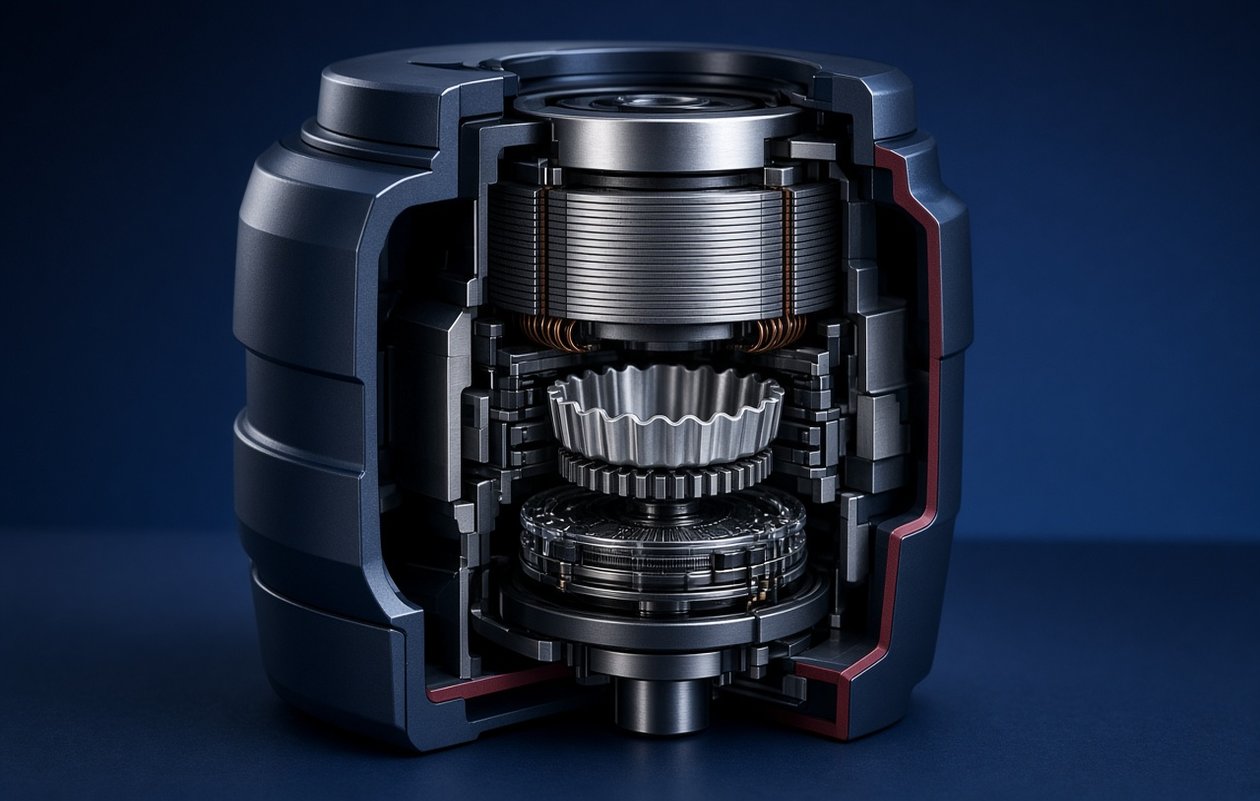
A joint actuator is the complete motion unit at a robot joint. It consists of a motor that generates torque, a transmission that reduces speed and multiplies torque, and usually an encoder that provides position feedback.
The transmission is often the component that defines overall performance, because it sits between the motor and the load and determines how much of the motor output actually reaches the joint. This is why harmonic reducers dominate robot joint design: they convert a fast, low torque motor input into a slow, high torque output with high transmission efficiency and very low backlash.
Actuator Types Compared
1
Electric Servo Actuators
Electric servo actuators are the most common type in modern robots. A servo motor is paired with a precision reducer, and the combination offers excellent control, repeatability, and scalability. The reducer can be harmonic, cycloidal, or planetary, and each brings a different balance of precision, torque density, and cost. For robot joints, harmonic reducers are the most widely used because of their combination of compact size and near zero backlash.
2
Direct-Drive and Hydraulic Actuators
Direct drive actuators remove the reducer entirely, which eliminates backlash by definition but requires a much larger motor to produce the same torque. They are used in specialized low speed, high precision applications. Hydraulic actuators can deliver very high force, which is why they appear in heavy load legged robots, but they are heavy, complex to control, and harder to maintain. Both serve niche roles, while the servo plus reducer combination remains the mainstream choice for industrial and humanoid robots.
| Actuator type | Torque density | Precision | Complexity | Typical use |
|---|---|---|---|---|
| Servo + harmonic reducer | High | Excellent | Medium | Robot arms, humanoids |
| Servo + planetary | Medium | Good | Low | Simple positioning |
| Direct drive | Application-dependent | Excellent | Low | Low speed precision |
| Hydraulic | Very high | Fair | High | Heavy load legged robots |
Key Selection Parameters
Torque, Speed and Reduction Ratio
Selection starts with the load. The peak torque the joint will ever see and the continuous torque it will carry during normal operation define the actuator size. From there, the reduction ratio is chosen to balance speed and torque: a higher ratio gives more torque at the output but a lower maximum speed. Harmonic reducers offer ratios from 50:1 to 160:1 in a single compact stage, which is one reason they fit so naturally into robot joints where space is tight.
Backlash, Stiffness and Service Life
Backlash is the play between the input and output of the transmission, and it directly affects positioning repeatability. Stiffness determines how much the joint deflects under load, which affects stability and accuracy during motion. Service life determines how often the actuator needs maintenance or replacement. A precision grade joint actuator is expected to show near zero backlash, high stiffness, and a service life of 10,000 hours or more, depending on the model and operating conditions, and these three parameters are usually the first things an experienced buyer checks.
The Rise of Integrated Joint Modules
One of the clearest trends in robot actuation is integration. Instead of buying a reducer, a motor, an encoder, and a drive separately and assembling them, robot builders increasingly choose a single joint module that combines all four. Integration reduces assembly time, eliminates interface errors between components, and cuts weight, all of which matter enormously in humanoid robots where every gram affects battery life and dynamics. It also simplifies the supply chain, because the builder deals with one qualified component instead of four.
Choosing Between a Reducer and a Joint Module
The choice between building a joint from separate parts and buying an integrated module depends on volume and development stage. A low volume research platform might benefit from separate components because they are easier to swap and tune. A robot heading toward mass production usually moves to integrated modules, because the assembly savings and consistency across units become decisive. Many teams start with reducers to validate the design, then transition to joint modules as they scale. Laifual Drive supports both paths, with a reducer line for custom builds and an L-series (DC Low Voltage) and M-series (AC High Voltage) joint module lines for integrated designs.
There is also a practical difference in how the two options behave on the shop floor. With separate components, the builder takes responsibility for alignment, preload, and tuning, which is fine for a small number of units but hard to repeat across hundreds. With an integrated module, those variables are set at the factory and tested as a unit, so every joint that arrives at the assembly line behaves the same as the last one. For humanoid robots, where a single platform may use thirty or forty joints, that consistency is what makes the difference between a reliable product and a constant debugging exercise.
Common Mistakes in Actuator Selection
Sizing Only for Peak Torque
Designers often size an actuator for the peak torque in the duty cycle and ignore the continuous requirement. The motor then overheats during normal operation because the RMS load is higher than the rated continuous torque. The correct approach is to compute both the peak and the RMS torque over the full cycle and check them against the motor and reducer ratings separately.
Ignoring Inertia Matching
The ratio between the load inertia and the motor inertia affects how well the servo loop can control the joint. A mismatch that is too large makes the system sluggish or prone to oscillation. Adding the reducer to the calculation changes the reflected inertia, so the motor, reducer, and load have to be treated as one system rather than three independent parts.
Choosing Backlash by Price Rather Than Task
A joint that reverses direction frequently needs near zero backlash, while a joint that runs in one direction most of the time can tolerate some play. Buying more precision than the task requires wastes money, and buying less destroys performance. The task profile should drive the backlash specification, not the other way around.
Future Trends in Robot Actuation
Three trends are visible in robot actuation today. The first is integration, which we have already covered: reducers, motors, and drives are moving into single modules. The second is higher torque density, driven by humanoid robots that must carry their own power source, and by collaborative arms that must handle heavier payloads without growing heavier themselves. The third is intelligence, with encoders and drive electronics adding sensing and communication so that each joint reports its own state to the central controller. These trends reinforce each other, and they all point in the same direction: the actuator is becoming the unit of robot design, not the sum of its parts.
FAQ
What is the best actuator type for a robot arm?
For most arms, a servo motor with a harmonic reducer offers the best balance of precision, torque density, and control.
Why is backlash so important in actuators?
Backlash creates play between the motor and the output, which degrades repeatability and stability, and that is unacceptable for precise manipulation.
Are integrated joint modules worth the cost?
For multi joint robots heading to production, yes. Integration cuts weight, assembly effort, and failure points, which usually outweighs the higher unit cost.
How do I size an actuator for a new joint?
Start with the peak and continuous torque, the required speed, and the target service life, then select the motor and reducer together.
Contact Us
Need help selecting actuators for your robot? The engineering team at Laifual Drive can review your load requirements and recommend a transmission solution. Technical articles and company updates are available under news.