The Components Inside a Humanoid Robot: A Complete Breakdown
Layer-by-layer look at humanoid robot components, why the motion layer dominates cost, and how harmonic reducers and joint modules set performance limits.
 August 24, 2026
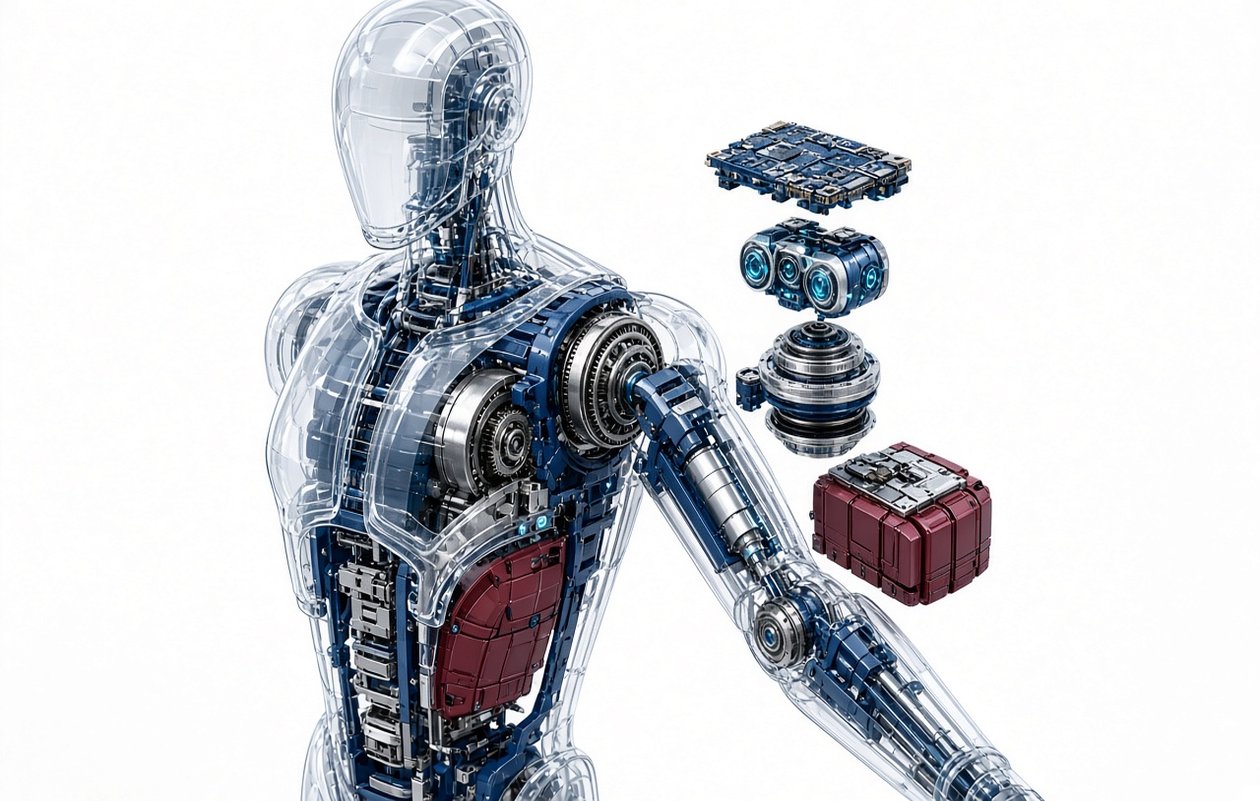
 > The Components Inside a Humanoid Robot: A Complete Breakdown
 A humanoid robot looks like a person, but underneath the shell it is a densely packed machine. Dozens of motors, hundreds of sensors, powerful computers, and a battery that has to move all of it, all fitted into the volume of a human body. For anyone building, buying, or investing in this technology, understanding what is inside a humanoid robot, and which components actually decide its performance, is essential. This article breaks down the machine layer by layer, with a focus on the parts that are easiest to underestimate and hardest to change later.
Anatomy of a Humanoid Robot
A humanoid can be divided into four layers. The motion layer is the joints and actuators that produce movement. The perception layer is the sensors that see, hear, and feel the world. The compute layer is the hardware that runs the AI and control software. The power layer is the battery and the electronics that distribute energy. Each layer has its own engineering challenges, but the motion layer deserves special attention because it is the largest by mass, the most mechanically complex, and the one most often underestimated by teams coming from a software background.
1
Motion Layer
Joints and actuators that produce movement. This layer consumes a large share of both cost and mass, and it sets the performance ceiling for the entire machine.
2
Perception Layer
Cameras, LiDAR, microphones, force and torque sensors, IMUs, and joint encoders that build a model of the environment and the robot body itself.
3
Compute Layer
AI accelerators and control hardware that run perception, planning, and control software, often at 30 to 60 hertz or higher.
4
Power Layer
Battery packs and power electronics that distribute energy. Every gram saved in the motion layer extends runtime directly.
Joints and Actuators: The Motion Layer
Why Joints Dominate the Build
Many humanoid robots have 20 to 40 or more actuated joints, depending on the design, and each one requiring a motor, a transmission, and an encoder, the motion layer consumes a large share of both cost and mass. The transmission is the performance gate within each joint. Harmonic reducers provide the near zero backlash and torque density that let a joint move precisely under load, and they do it in a package small enough to fit inside an arm or a leg. Choosing the right reducer is effectively choosing the robot capability ceiling.
Integrated Joint Modules
To save mass and assembly time, many humanoid builders adopt integrated joint modules, which combine reducer, motor, encoder, and drive in a single package. The benefit compounds across the whole machine. Reducing motion-system mass can lower overall energy demand and may allow designers to reduce battery capacity or extend operating time, depending on the system-level design, which means either lower cost or longer runtime. It also simplifies assembly, because one module replaces four separately sourced parts that would otherwise need alignment and tuning on the line.
Sensors: Eyes, Skin and Proprioception
Cameras and LiDAR give the robot sight, microphones add hearing, and force and torque sensors in the wrists and feet let it feel contact with the world. Inertial measurement units track orientation, and joint encoders report position. All of this data flows into the perception system, which builds a model of the environment and the robot body itself. The result is a constant stream of information that the AI uses to plan motion. But there is an important detail that is easy to miss: the plan is only as good as the joints that execute it. A sensor suite can read the position correctly and the robot will still fail if the transmission cannot move the joint to the commanded position.
Compute and Power
The Brain
Humanoids run neural networks on dedicated AI accelerators for perception, planning, and control, often at 30 to 60 hertz or higher. The compute stack has to be power efficient, because every watt it draws comes from the battery, and the cooling problem inside a sealed humanoid torso is real. Teams spend as much effort on thermal management of the compute as on the compute itself.
The Battery
Typical humanoids carry one to five kilowatt hour battery packs and run for one to four hours depending on activity. Every gram saved in the motion layer, and every bit of friction removed from the transmission, extends runtime directly. This is why the mechanical design and the power budget are discussed together, and why a high efficiency transmission is not a luxury but a range extension strategy.
Why the Motion Layer Determines Performance
The easiest way to see why the motion layer matters is to imagine a robot with perfect perception and perfect AI but weak joints. It knows exactly where the cup is, it plans the perfect grasp, and then it fumbles because the wrist lacks precision or the arm lacks stiffness. The reverse combination, modest AI with excellent joints, produces a robot that is clumsy but reliable, and reliability is what earns a robot a place on a production line. Precision, speed, and endurance all trace back to the actuation system. Component selection, not just software, decides how capable a humanoid really is.
Cost Drivers and Where the Money Goes
Cost Breakdown Patterns
Cost breakdowns of humanoid robots consistently highlight one clear pattern: The motion system can represent a significant portion of humanoid robot cost, particularly because it includes multiple motors, transmissions, encoders, and related electronics. Within this layer, transmission components represent the highest individual expense, followed by motors. Consequently, suppliers capable of volume-producing precision reducers exert outsized influence on the industry. Lower transmission costs and efficiency gains that permit smaller batteries directly improve overall robot economics, linking component supply chains directly to end-market pricing.
| Cost Category | Typical Priority | Notes |
|---|---|---|
| Transmission components | Highest individual expense | Harmonic reducers per joint set performance limits |
| Motors | Second highest | One motor per actuated joint |
| Encoders and drives | Significant | Scale directly with joint count |
| Sensors and compute | Growing share | Perception and AI hardware add cost but depend on joint execution |
This cost structure also clarifies why humanoid pricing will decline sharply over the coming years. As production volumes scale, reducers, motors, and sensors will move down standard manufacturing learning curves. Integrated joint modules accelerate this trend by cutting assembly labor and factory testing time. As a result, motion layer cost reductions will drive today’s hundred-thousand-dollar machines down to a fraction of their current price. Recognizing this shift, major component suppliers are already investing heavily in automation and capacity to capture market share.
FAQ
What is the most expensive part of a humanoid robot?
The motion layer, actuators and reducers together, is typically the largest single cost center in the bill of materials.
How many sensors does a humanoid have?
Dozens to hundreds depending on the design, including cameras, IMUs, force torque sensors, and joint encoders.
Why do humanoids need precision reducers?
Each joint needs near zero backlash and high torque density to move precisely under load, and harmonic reducers deliver both in a compact package.
How long does a humanoid run on battery?
Typically one to four hours, and a lighter, more efficient motion layer extends runtime directly.
Building a humanoid and need precision components? The engineering team at Laifual Drive can help with reducer and joint module selection for robotic systems.