Why Do Humanoid Robots Need So Many Joints
Learn why humanoids use 20 to 40+ actuated joints, how DOF maps to arms and legs, and why precision transmission drives cost and performance.
 August 04, 2026
 > Why Do Humanoid Robots Need So Many Joints
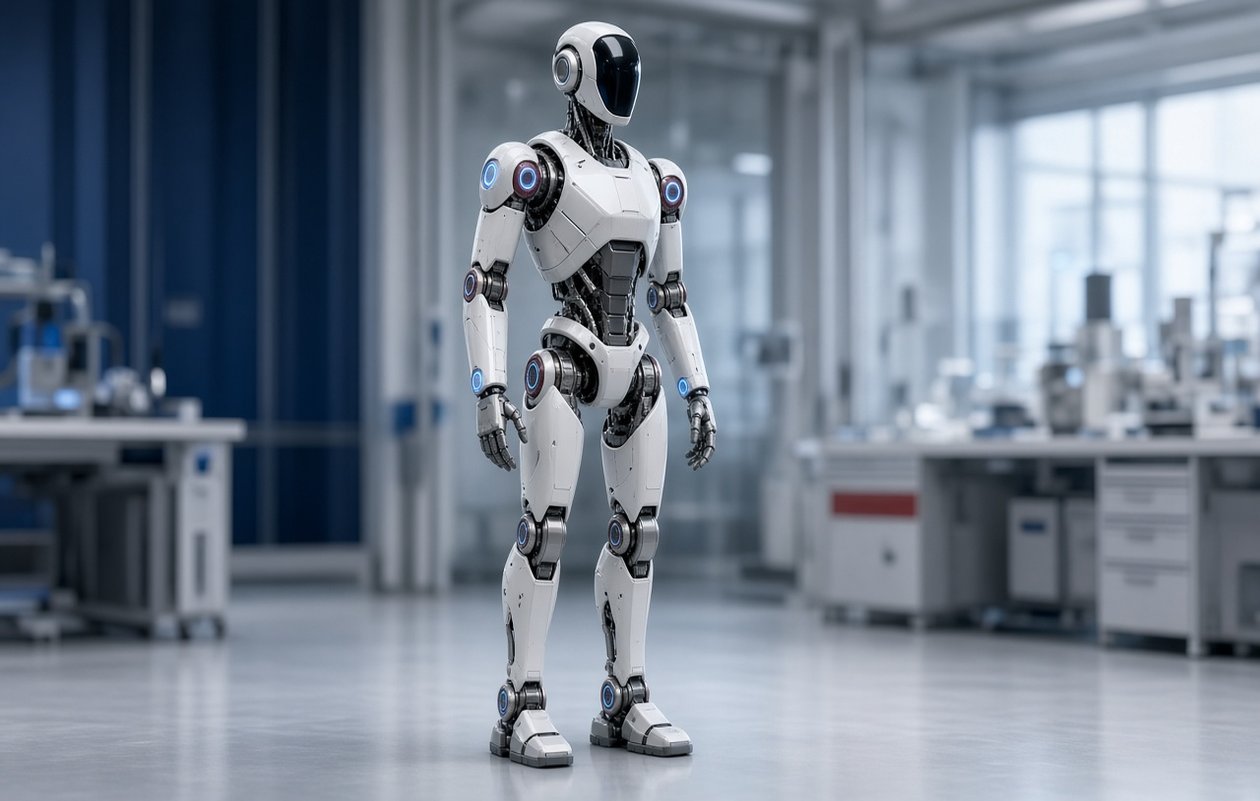
 Stand next to a modern humanoid robot and the first thing you notice is how much of it can move. Arms, wrists, fingers, torso, hips, knees, ankles, all working independently, all coordinating in real time. Many humanoid robots have around 20 to more than 40 actuated joints, depending on the design, and each one is a small mechanical system of its own, complete with a motor, a transmission, and position feedback. The question that follows is a natural one: why do humanoid robots need so many joints?
The short answer is that complex tasks demand complex motion. But the longer answer, the one that matters to engineers and buyers, is about what those joints do, why they place such strict demands on transmission components, and how those components are actually chosen.
How Many Joints Does a Humanoid Robot Have?
Engineers measure joint count in degrees of freedom, usually abbreviated as DOF. A basic upper body humanoid might use around 20 DOF, while advanced full body platforms exceed 40. Every extra joint adds capability, but it also adds weight, cost, and control complexity, so designers are constantly balancing dexterity against practical limits. The balance they strike shows up directly in the robot bill of materials, which is why joint count is one of the first specifications a buyer asks about.
The table gives a sense of where the joints go. Arms and hands can account for a significant share of the total joint count, which is why so much engineering effort in humanoid development goes into compact actuation. The joints in the torso and legs are fewer in number but carry the structural load, and they have to keep the whole machine stable while it moves.
| Robot section | Typical DOF | What it enables |
|---|---|---|
| Head and neck | 2 to 3 | Vision tracking, expressions |
| Each arm | 6 to 7 | Reach, orientation, manipulation |
| Each hand | 5 to 15 | Grasping, tool use |
| Waist or torso | 1 to 3 | Balance, extended reach |
| Each leg | 5 to 6 | Walking, balance |
What Each Joint Does
Shoulders, Elbows and Wrists
Arm joints give the robot a large reachable workspace. A shoulder typically uses two or three axes for spherical motion, the elbow adds one more, and the wrist provides two or three for orientation. Every one of these axes needs a compact transmission with high torque density, and this is one area where harmonic reducers are widely used. They deliver a high reduction ratio in a very small envelope, which allows designers to fit more joints into the same arm length without adding bulk, and their near zero backlash keeps each axis accurate.
Hips, Knees and Ankles
Leg joints carry the full body weight during standing, walking, and squatting, so they need high torque density and low backlash. Balance control depends on each joint responding exactly as commanded, and a small error at the hip is amplified by the length of the leg, which means the transmission has to be genuinely precise. Integrated joint modules, which combine reducer, motor, and drive in a single package, are increasingly used in this part of the body because they save weight at exactly the point where every gram matters.
Why Every Joint Needs Precision Transmission
The reason precision matters so much is that more joints mean more places where error can build up. If each joint contributes even a small amount of backlash or compliance, the combined error at the hand or foot becomes significant, and a robot reaching for a part can miss by several millimeters even when every individual joint is within specification. Low-backlash transmissions can help reduce error accumulation across the kinematic chain and support accurate, repeatable motion. That is what makes the difference between a robot that walks smoothly on uneven ground and one that stumbles, or between one that can handle fragile objects and one that crushes them. It is also what allows a machine to repeat the same motion reliably hour after hour.
Degrees of Freedom in Real Applications
The value of many joints is easiest to see in real tasks. Consider a robot that has to pick a part from a bin and insert it into a machine. The arm needs enough reach to cover the workspace, enough wrist freedom to align the part, and enough hand freedom to grip it. A six axis arm can do the job, but it often has to reposition the whole arm just to orient the wrist. A seven axis arm can keep the wrist at a favorable angle while the elbow and shoulder adjust, which reduces collisions and makes programming simpler.
Humanoids push this logic much further. They add torso rotation, a neck, and dexterous hands because they are built for unstructured environments where a fixed base and a simple gripper are not enough. The same logic applies to the legs. Walking is not a single motion but a sequence of coordinated joint movements: the hip lifts the leg, the knee bends it, the ankle orients the foot, and the torso shifts the weight. Each joint must coordinate closely with the others, often with millisecond-level control and sensing requirements, and any lag or play shows up as stumbling or wasted energy. That is why legged robots are among the most demanding applications for precision transmission.
The Trade-Off: More Joints, More Complexity
Of course, every added joint brings extra weight, extra power draw, and extra failure modes. A 40-DOF humanoid generally requires more actuators and associated components than a 20-DOF machine, but the exact increase depends on the system architecture. Designers therefore choose the minimum number of joints that can handle the target tasks, then optimize each one for mass and efficiency. Component choices matter a great deal in this calculation, because a lighter and more efficient transmission allows more joints within the same weight and power budget. This is one of the main reasons the motion layer dominates both the cost and the performance of a humanoid robot.
Thermal management also scales with joint count. Every actuator generates heat, and heat shortens component life and degrades accuracy over time. A robot with forty joints has to shed the combined heat of forty motors, usually from a compact body with limited surface area, so designers rely on efficient motors, low friction transmissions, and careful duty cycle planning. The transmission contributes directly here, because friction in the reducer is converted into heat. Lower friction means less heat to remove, which translates into a cooler running joint and a longer service life.
How Laifual Drive Supports Multi-Joint Robots
Laifual Drive supplies the precision transmission components used in humanoid and industrial robots. The product line covers compact harmonic reducers for arms and wrists, plus higher torque joint modules for legs and shoulders. Selected models can achieve positioning accuracy of ±15 arcseconds and rated service life exceeding 10,000 hours, depending on the product and operating conditions, and these numbers matter in a multi joint platform because accuracy and life are multiplied across dozens of joints. For a robot builder, the practical question is not whether one joint can be accurate, but whether forty joints can stay accurate over thousands of operating hours.
Batch consistency is just as important as the headline numbers. A humanoid needs dozens of joints that behave the same way, because control software assumes identical dynamics across all of them. If one joint has slightly more friction or backlash than its neighbor, the robot has to compensate, and that compensation costs speed and accuracy. Suppliers that hold tight tolerances across production batches make the integrator job measurably easier. Laifual Drive manufactures reducers and joint modules on dedicated production lines with full chain control, from raw materials through gear cutting, heat treatment, assembly, and testing, so that consistency is built in rather than hoped for.
Browse Transmission Products
FAQ
Why do robots not just use fewer, simpler joints?
Because tasks like grasping, walking, and manipulation physically require many degrees of freedom. Fewer joints means less dexterity and less mobility.
Do more joints make a robot harder to control?
Yes, but modern learning based control handles high DOF systems well, provided the mechanical joints are precise and repeatable.
Which joints need the strongest transmission?
The leg joints and the shoulder, because they carry the most load. They need high torque density and high stiffness.
Why are harmonic reducers common in robot arms?
They offer high reduction ratios, near zero backlash, and a compact size, which fits the tight envelopes of arm and wrist joints.
Contact Us
Designing a multi joint robot? The engineering team at Laifual Drive can help with transmission selection and joint design. Company updates and technical articles are published under news.