Understanding Harmonic Drive Components
Learn all about harmonic drive components including wave generator, flexspline and circular spline. Explore core strain wave gear parts & working principle for precision motion control.
 June 03, 2026
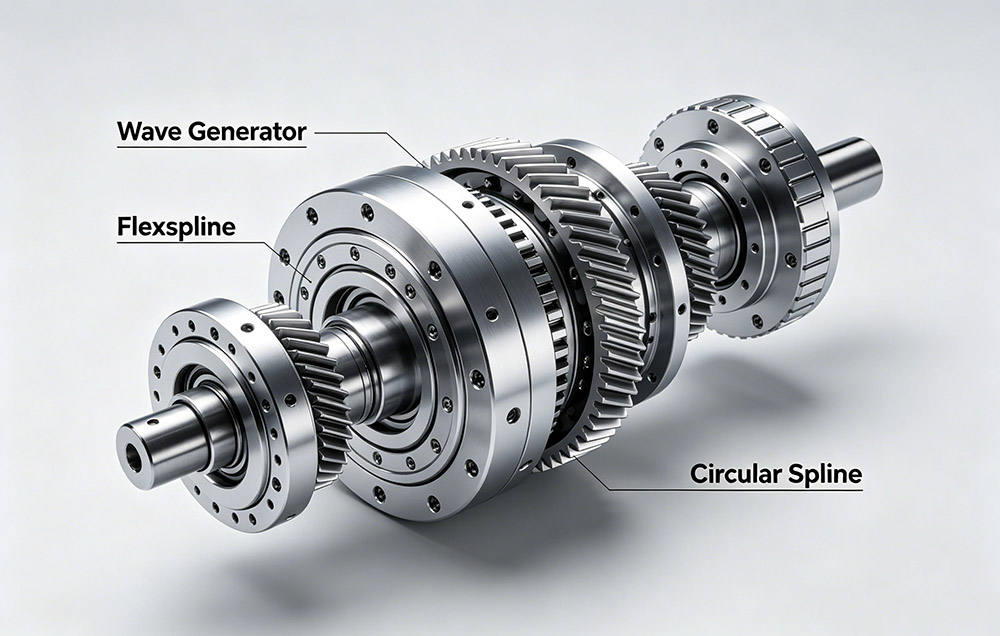

Precision motion control is essential in modern automation, from industrial robots and semiconductor equipment to medical and aerospace systems. Harmonic drives are widely recognized for their ability to deliver high reduction ratios, compact design, and exceptional positioning accuracy.
Their performance relies on key components such as harmonic drive gears, gear sets, and cup-type component sets, which work together to provide precise and reliable motion transmission.

Key Takeaways
- Harmonic drives provide high reduction ratios in a compact and lightweight design.
- A standard harmonic drive consists of three primary elements: the wave generator, flexspline, and circular spline.
- Component gear sets offer design flexibility for custom equipment and integrated motion systems.
- Cup-type component sets are widely used in robotics and automation due to their compact structure and high torque density.
- Harmonic drive gears deliver excellent positioning accuracy with minimal backlash.
- Understanding the characteristics of each component can simplify system design and improve overall performance.
What Are Harmonic Drive Components?
A harmonic drive is a strain-wave gearing system that transfers motion through elastic deformation of a flexible gear. Unlike traditional planetary or spur gear mechanisms, harmonic drives rely on controlled flexing of a thin-walled spline to achieve motion reduction.
Although harmonic drives are available as fully assembled gear units, many manufacturers also provide component-level solutions. These components allow engineers to integrate the transmission directly into custom equipment while optimizing weight, space, and performance.
Most harmonic drive systems are built around three core components:
- Wave Generator
- Flexspline
- Circular Spline
Together, these elements create the precise motion characteristics that harmonic drives are known for.
The Three Core Harmonic Drive Gears
Wave Generator
The wave generator serves as the input element of the harmonic drive system.
It typically consists of an elliptical cam fitted with a special thin-section bearing. As the input shaft rotates, the elliptical shape forces the flexspline to deform into an elliptical profile.
This controlled deformation creates two engagement zones between the flexspline and circular spline. As the wave generator continues rotating, the engagement zones travel around the circumference of the gears, generating motion reduction.
The wave generator contributes to:
- Smooth torque transmission
- High rotational accuracy
- Stable engagement between gears
- Efficient motion transfer
Because of its influence on gear meshing quality, the wave generator directly affects positioning performance and service life.
Flexspline
The flexspline is perhaps the most distinctive component within a harmonic drive.
It is a thin-walled, flexible gear with external teeth. The cup-shaped structure allows it to deform elastically while maintaining sufficient strength to transmit torque.
When the wave generator rotates, the flexspline continuously changes shape, allowing its teeth to engage with the circular spline at opposite sides of the gear.
Since the flexspline contains fewer teeth than the circular spline, each rotation produces a small relative displacement between the two gears. This difference creates the reduction ratio.
The flexspline offers several advantages:
- Lightweight construction
- Compact packaging
- High torque capacity
- Excellent positional repeatability
- Low backlash performance
Circular Spline
The circular spline is the rigid outer gear that surrounds the flexspline.
It contains internal teeth and typically has slightly more teeth than the flexspline. Depending on the application, the circular spline may be fixed or act as an output component.
Its rigid construction provides:
- Structural stability
- Consistent gear engagement
- Accurate torque transmission
- Long operational life
The interaction between the circular spline and flexspline forms the basis of harmonic drive motion reduction.
Understanding Harmonic Drive Gear Sets
A harmonic drive gear set is the fundamental transmission package containing the essential gearing elements without additional housings, output bearings, or motor interfaces.
For engineers designing custom machines, gear sets provide greater flexibility because they can be integrated directly into existing mechanical structures.
Typical harmonic drive gear sets include:
- Wave generator
- Flexspline
- Circular spline
Some versions may also include mounting features that simplify installation into equipment.
Benefits of Component Gear Sets
Compact Integration
Many advanced machines have strict space limitations. Component gear sets allow designers to integrate the transmission directly into surrounding structures, reducing overall system size.
Weight Reduction
Removing external housings and unnecessary components helps lower total weight. This is especially valuable in robotic arms and aerospace applications where moving mass affects performance.
Design Flexibility
Engineers can customize bearing arrangements, output structures, and mounting interfaces to match specific project requirements.
High Precision
Even without a fully enclosed housing, harmonic drive gear sets retain the positioning accuracy and low backlash characteristics associated with strain-wave gearing technology.
What Are Cup Type Component Sets?
Cup type component sets are among the most popular harmonic drive configurations used in automation equipment.
The term “cup type” refers to the shape of the flexspline. Instead of a flat profile, the flexspline forms a cylindrical cup with a thin flexible wall and a rigid flange.
This design enables efficient elastic deformation while maintaining excellent torque transmission capability.
Structure of a Cup Type Component Set
A typical cup type component set includes:
- Cup-shaped flexspline
- Circular spline
- Wave generator
- Supporting mechanical interfaces
The cup structure provides a favorable balance between strength, flexibility, and compactness.
Advantages of Cup Type Component Sets
| Feature | Description |
| High Torque Density | Cup type designs can transmit significant torque relative to their size and weight, making them ideal for robotic joints and compact automation systems. |
| Excellent Positioning Accuracy | Minimizes backlash and improves repeatability, enabling precise motion control during complex movement sequences. |
| Compact Design | Delivers high performance within limited installation space, making it suitable for space-constrained systems. |
| Smooth Operation | Continuous tooth engagement helps reduce vibration and improve motion quality, particularly at low speeds. |
| Wide Range of Applications | The unique characteristics of harmonic drive components make them suitable for various industries and precision motion control applications. |
Applications of Harmonic Drive Components
The unique characteristics of harmonic drive components make them suitable for a wide variety of industries.
| Industry / Application | Benefits and Typical Uses |
| Industrial Robotics | Supports precise positioning in robotic joints with compact dimensions. Benefits include accurate trajectory control, high torque output, lightweight joint structures, and smooth movement. |
| Collaborative Robots | Low backlash and high repeatability improve control accuracy and safety when operating close to people and performing delicate tasks. |
| Semiconductor Manufacturing Equipment | Provides the extreme precision required for wafer handling systems, inspection equipment, lithography positioning stages, and precision automation modules. |
| Medical Devices | Enables smooth and reliable motion in surgical robots, rehabilitation equipment, diagnostic imaging devices, and laboratory automation systems. |
| Aerospace and Defense | Supports compact motion systems while reducing weight and maintaining the high precision required in demanding aerospace and defense environments. |
Why Harmonic Drive Gears Deliver Low Backlash
One of the most recognized characteristics of harmonic drives is their exceptionally low backlash.
Traditional gear systems often require clearance between mating teeth to prevent binding. This clearance can introduce positioning errors during direction changes.
In harmonic drives, a large number of teeth engage simultaneously. Because the flexspline remains in continuous contact with the circular spline across multiple teeth, clearance is greatly reduced.
The result is:
- Improved positioning accuracy
- Better repeatability
- Smoother motion control
- Enhanced servo performance
For applications involving robotics, inspection systems, and precision manufacturing, these advantages can significantly improve overall machine performance.
Choosing the Right Harmonic Drive Components
Selecting the appropriate harmonic drive components depends on several factors.
| Selection Factor | Description |
| Required Reduction Ratio | Higher ratios provide greater torque multiplication but reduce output speed. The selected ratio should match the application’s performance requirements. |
| Torque Requirements | Both continuous torque and peak torque demands should be evaluated to ensure reliable and stable operation. |
| Available Installation Space | Compact applications may benefit from cup type component sets or integrated gear sets that minimize overall dimensions. |
| Accuracy Requirements | Applications involving positioning, tracking, or coordinated motion often require low backlash and high repeatability. |
| System Integration Strategy | Some projects benefit from complete housed units, while others achieve greater optimization through component-level integration. |
Understanding these requirements early in the design process can simplify component selection and improve long-term performance.
Conclusion
Harmonic drives continue to play an important role in precision motion control because they combine compact size, high reduction ratios, and exceptional positioning performance within a single transmission solution.
At the heart of every harmonic drive are three key elements: the wave generator, flexspline, and circular spline. Together, these harmonic drive gears create the unique strain-wave motion principle that delivers smooth and accurate movement.
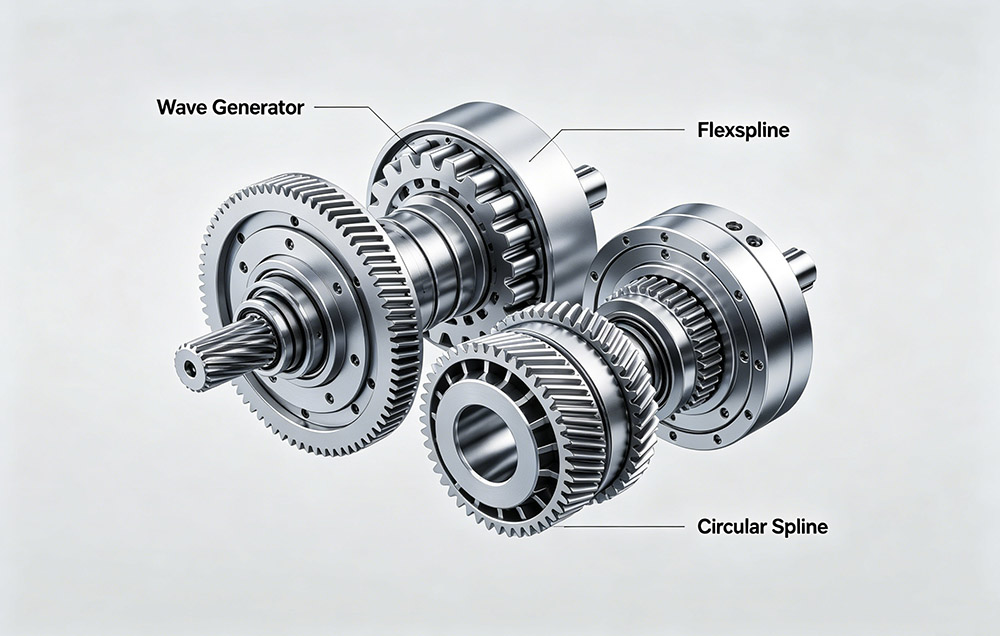
Explore our harmonic drive components and find the right solution for your motion control project. If you’d like help with selection or specifications, we’re always happy to assist.
Q1 What components make up a harmonic drive?
A harmonic drive typically consists of three primary components: a wave generator, a flexspline, and a circular spline. These parts work together to create motion reduction through controlled elastic deformation.
Q2 What is a harmonic drive gear set?
A harmonic drive gear set contains the core transmission elements without a complete housing. It generally includes the wave generator, flexspline, and circular spline, allowing integration into custom mechanical designs.
Q3 What is the difference between a gear set and a housed unit?
A gear set contains only the essential gearing components, while a housed unit includes additional elements such as bearings, housing structures, and mounting interfaces for easier installation.
Q4 Why are cup type component sets widely used in robotics?
Cup type component sets offer high torque density, compact dimensions, low backlash, and excellent positioning accuracy, making them well suited for robotic joints and automated machinery.
Q5 Do harmonic drives have backlash?
Harmonic drives are known for extremely low backlash compared with traditional gear systems. Their multi-tooth engagement design helps minimize positioning errors and improve repeatability.
Q6 What industries commonly use harmonic drive components?
Harmonic drive components are widely used in robotics, collaborative robots, semiconductor equipment, medical devices, aerospace systems, defense applications, and precision automation machinery.
Q7 Can harmonic drives operate at high reduction ratios?
Yes. One of the major advantages of harmonic drives is their ability to achieve high reduction ratios within a compact package, often eliminating the need for multiple gear stages.
Q8 How do I choose the right harmonic drive component set?
Selection typically depends on reduction ratio, torque requirements, installation space, accuracy needs, and integration preferences. Evaluating these factors helps identify the most suitable solution for a specific application.