Harmonic Drive in Medical Technology
Discover harmonic drive in medical technology for surgical robots, CT/MRI positioning & rehabilitation devices with zero-backlash precision.
 June 24, 2026
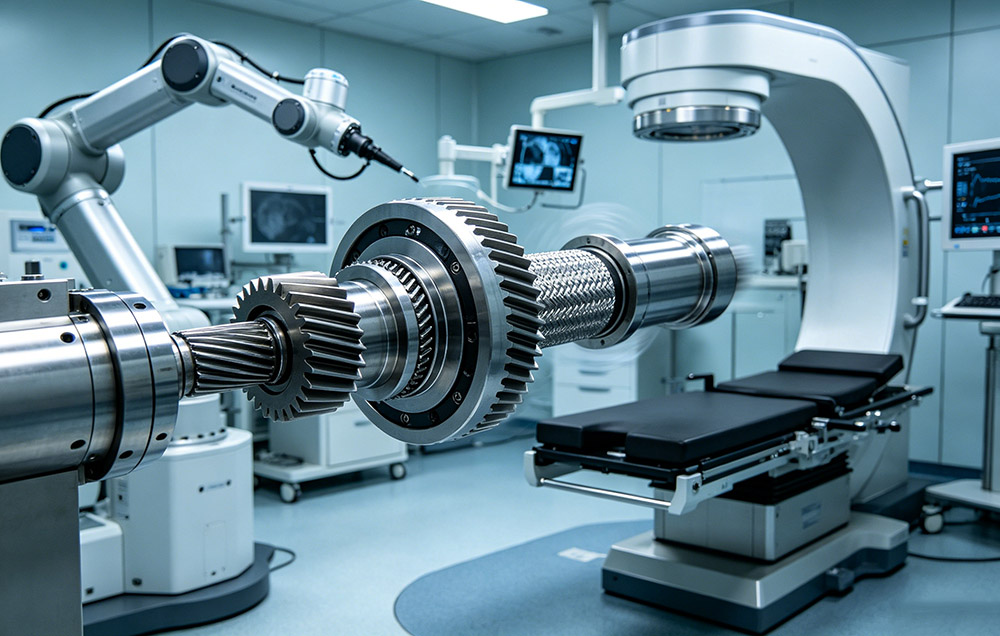

As medical equipment becomes more advanced, manufacturers are placing greater emphasis on precise motion control, compact system design, and reliable performance.
Applications such as surgical robots, imaging devices, and rehabilitation systems require smooth and accurate movement within a limited space.
Harmonic drive systems are well-suited to these requirements, offering compact dimensions, high torque density, low backlash, and consistent positioning performance for a wide range of medical applications.

Core Takeaways
- Harmonic drive systems provide extremely high positioning accuracy with near-zero backlash
- Compact structure allows integration into space-limited medical devices
- High torque density supports heavy load movement in small actuators
- Commonly used in surgical robots, imaging systems, and rehabilitation equipment
- Designed for long-term reliability and repeatable precision in critical environments
Precision Motion Requirements in Medical Systems
Modern medical devices rely heavily on controlled motion at microscopic scales. In robotic-assisted surgery, even a slight deviation can affect procedural outcomes. In imaging platforms such as CT scanners and MRI positioning tables, smooth and repeatable rotation ensures clearer imaging results and patient comfort.
Traditional gear systems often introduce backlash or vibration, which can reduce accuracy. Harmonic drive technology addresses these challenges by using a flexible spline mechanism that enables highly controlled motion transmission.
This makes it particularly suitable for equipment such as:
- Robotic surgical arms
- Endoscopic positioning systems
- Radiotherapy positioning platforms
- Diagnostic imaging gantries
- Patient positioning tables
How Harmonic Drive Systems Work in Medical Applications
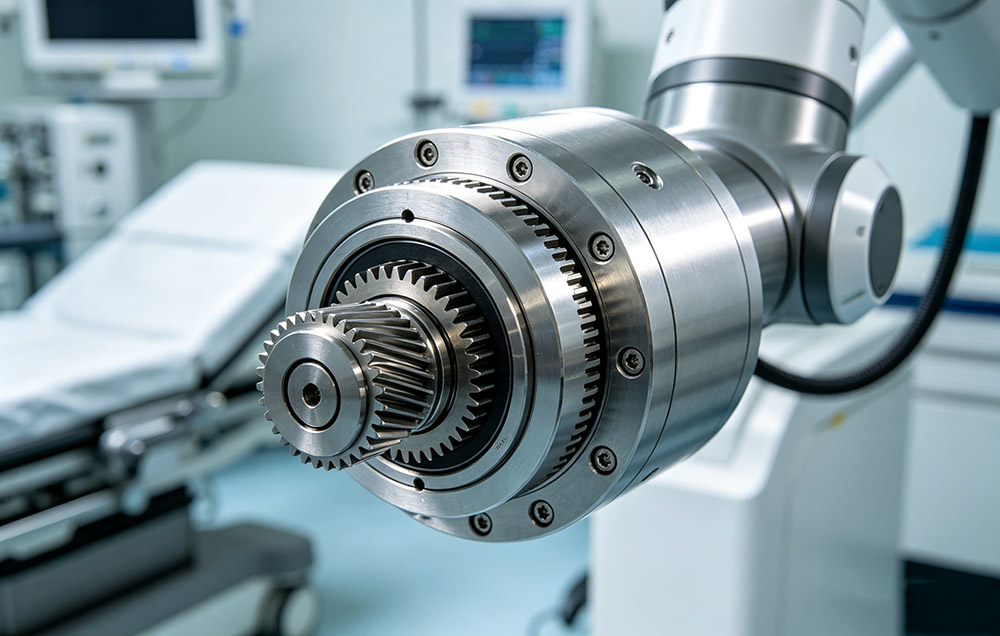
A harmonic drive system typically consists of three main components: a wave generator, a flex spline, and a circular spline. The wave generator deforms the flex spline in a controlled elliptical shape, allowing teeth engagement at two opposing zones.
This mechanism enables:
| Feature | Description |
| High reduction ratios in a compact structure | Achieves large speed reduction within a small and space-efficient design. |
| Near-zero backlash motion transmission | Minimizes mechanical play for highly accurate motion control. |
| Smooth and continuous rotation output | Ensures stable and uninterrupted rotational movement. |
| High positioning repeatability | Maintains consistent and precise positioning over repeated operations. |
In medical devices, this structure is often integrated into servo actuators that directly drive robotic joints or precision positioning modules.
For example, in a robotic surgical system, harmonic drives are commonly installed in wrist joints of robotic arms, enabling surgeons to perform delicate movements such as suturing or tissue manipulation with high stability.
Applications in Surgical Robotics
Surgical robotics represents one of the most advanced applications of harmonic drive technology. Systems such as minimally invasive surgical robots rely on multiple precision joints working in coordination.
In these systems, harmonic drives are used in:
- Robotic arm joints for multi-degree-of-freedom movement
- End-effector control modules for surgical tools
- Wrist articulation units for fine manipulation
The ability to maintain smooth torque transmission without mechanical play helps surgeons translate hand movements into precise micro-movements inside the human body.
This is especially important in procedures like:
| Procedure Type | Importance of Precision |
| Laparoscopic Surgery | Requires highly precise and stable instrument control in minimally invasive environments. |
| Neurosurgery Assistance | Demands extremely accurate and delicate movements to avoid damage to sensitive neural tissues. |
| Orthopedic Minimally Invasive Operations | Needs controlled force and precise positioning for safe and effective bone and joint procedures. |
Role in Medical Imaging Equipment
Medical imaging systems require consistent rotational accuracy and vibration-free operation.
Harmonic drives are commonly used in:
- CT scanner gantry rotation systems
- MRI patient table positioning systems
- Ultrasound probe positioning arms
In CT scanners, the gantry rotates at high speed around the patient. Harmonic drive actuators help maintain stable rotation and reduce mechanical noise, contributing to clearer image reconstruction.
In MRI systems, patient positioning tables must move smoothly in multiple directions while maintaining exact alignment with imaging coordinates. Harmonic drive-based servo systems help achieve this level of precision.
Rehabilitation and Assistive Medical Devices
Beyond surgical and imaging systems, harmonic drive actuators are increasingly used in rehabilitation robotics and assistive technologies.
Examples include:
- Exoskeleton rehabilitation suits for stroke recovery
- Robotic prosthetic limbs with articulated joints
- Physical therapy motion training devices
In these applications, controlled torque output and smooth motion are essential for patient safety and comfort. Harmonic drives enable natural movement patterns while maintaining accurate control over joint angles.
For example, a lower-limb exoskeleton used in gait rehabilitation often relies on harmonic drive joints at the knee and hip to replicate natural walking motion with stability and repeatability.
High-Reliability Design Considerations
Medical environments require equipment that operates consistently under long duty cycles and strict regulatory conditions. Harmonic drive systems are often selected because they support:
| Feature | Description |
| Long service life with minimal wear | Designed to operate reliably over extended periods with reduced mechanical degradation. |
| Stable performance under repetitive motion cycles | Maintains consistent accuracy and operation during repeated movements. |
| Compact integration into sterilizable enclosures | Can be integrated into small designs suitable for sterilization requirements. |
| Compatibility with servo control systems | Works effectively with servo systems for precise motion control. |
In many cases, harmonic drives are paired with brushless servo motors and advanced feedback sensors to create closed-loop control systems. This combination enables precise motion control even under variable load conditions.
Design engineers often focus on thermal stability during continuous operation to ensure reliable performance over long periods of use. They also consider mechanical durability under cyclic loading to withstand repeated stress without failure. Backlash-free motion accuracy over time is another key concern, especially in precision applications where positioning consistency is critical.
In addition, noise reduction is important, particularly in patient-friendly environments such as medical systems where quiet operation improves comfort and usability.
Integration in Modern Servo Gear Trains
In advanced medical systems, harmonic drives are rarely used alone. They are integrated into complete servo gear train architectures that include motors, encoders, and control electronics.
A typical configuration may include:
| Component | Function |
| Brushless DC Servo Motor | Provides primary torque for system operation. |
| Harmonic Drive Reducer | Amplifies torque and ensures high-precision motion control. |
| High-Resolution Encoders | Provide accurate position feedback for closed-loop control. |
| Embedded Controllers | Handle motion planning and overall system coordination. |
This combination is widely used in robotic-assisted surgery platforms and automated diagnostic systems, where motion accuracy directly influences system performance.
Advantages in Medical Engineering Environments
The adoption of harmonic drive systems in medical technology is driven by several practical engineering advantages:
- High torque-to-weight ratio suitable for compact devices
- Extremely fine positioning capability
- Reduced mechanical complexity compared to multi-stage gear systems
- Compatibility with sterilization and cleanroom environments
- Stable performance in continuous operation scenarios
These characteristics allow engineers to design smaller, lighter, and more efficient medical devices without compromising precision.
Future Trends in Medical Motion Systems
As medical robotics and AI-assisted surgery continue to evolve, demand for more responsive and intelligent motion systems is increasing.
Harmonic drive technology is expected to play a growing role in miniaturized surgical robots designed for single-port surgery, where compact size and high precision are essential. It will also be increasingly used in AI-guided robotic positioning systems that require accurate and adaptive motion control.
In addition, wearable medical robotics for rehabilitation are likely to benefit from its smooth and reliable torque transmission. Harmonic drives are also anticipated to support hybrid imaging and treatment platforms, where precise and coordinated movement is critical for integrated medical procedures.
Integration with real-time feedback systems and smart control algorithms will further enhance motion accuracy and adaptability in complex medical environments.
Conclusion
Harmonic drive systems have become a key component in modern medical engineering, supporting a wide range of applications from surgical robotics to imaging systems and rehabilitation devices. Their ability to deliver precise, smooth, and reliable motion in compact designs makes them well suited for high-performance medical equipment.
As medical systems continue to demand higher accuracy and smaller form factors, harmonic drive-based actuators and gear systems will remain central to the development of next-generation medical technology.
Step into precision with our harmonic drive solutions for medical technology. We bring you high-reliability gears and actuators designed for surgical robotics, imaging systems, and advanced medical equipment. If you need support or have questions, feel free to contact us anytime.
Q1 What is a harmonic drive used for in medical equipment?
It is used to provide precise motion control in devices such as surgical robots, CT scanners, MRI tables, and rehabilitation systems.
Q2 Why is the harmonic drive preferred in surgical robots?
It offers zero backlash, high positioning accuracy, and smooth motion, which are essential for delicate surgical operations.
Q3 Can harmonic drives handle heavy loads in medical devices?
Yes, they provide high torque density, making them suitable for compact systems that still require strong load capacity.
Q4 Where are harmonic drives used in imaging systems?
They are commonly used in CT gantry rotation systems and MRI patient positioning platforms.
Q5 Are harmonic drives suitable for long-term medical use?
Yes, they are designed for high durability and stable performance under continuous and repetitive operation cycles.