July 05, 2026
The bill of materials for a humanoid robot typically includes actuators, structural components, sensors, computing hardware, batteries, and wiring harnesses.
Among these, the actuator system, and specifically the precision transmission elements within it, consistently emerges as one of the largest cost drivers and the most significant technical bottleneck for scaling production.
The Actuator Cost Structure
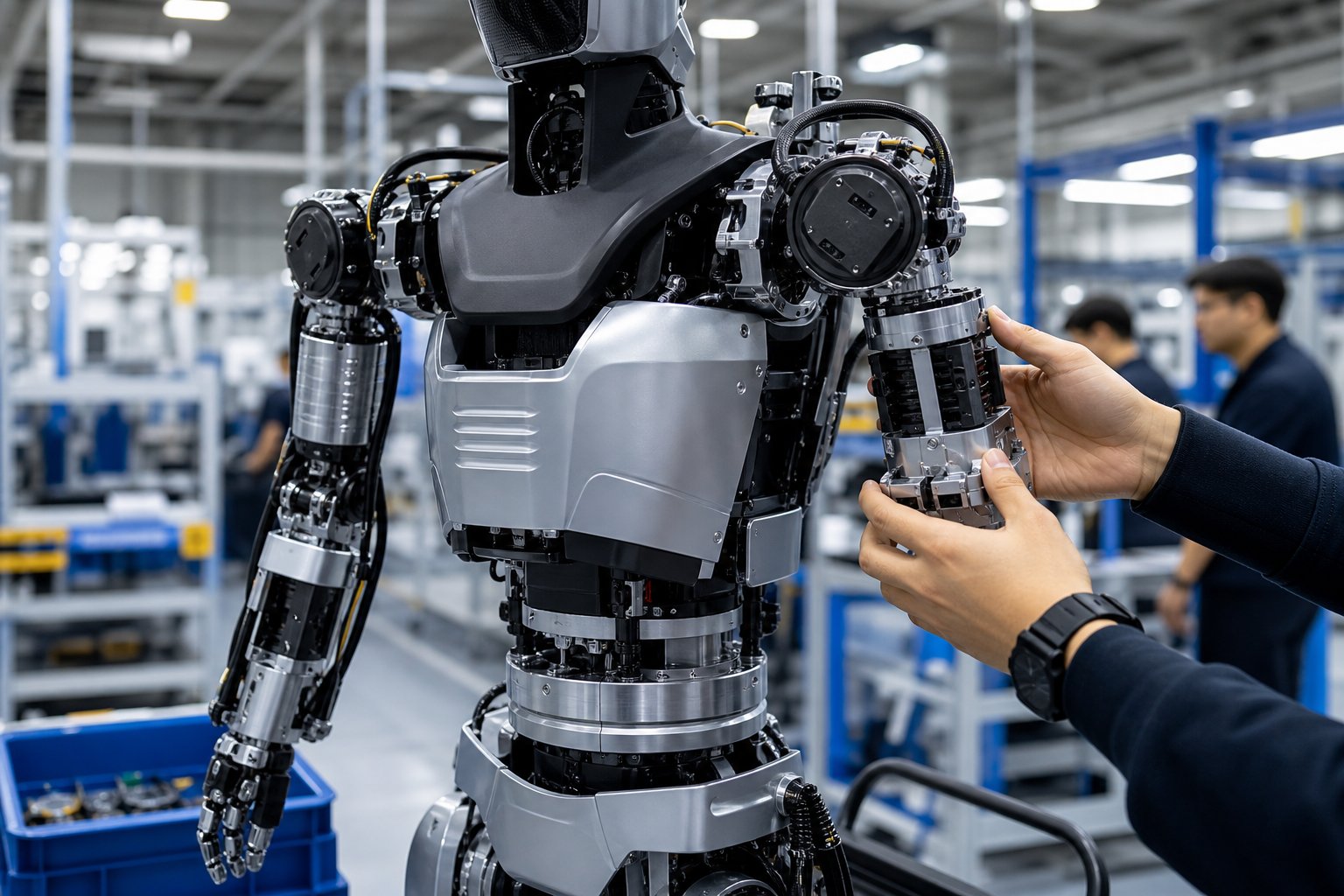
A typical humanoid robot uses between 28 and 50 rotary actuators, depending on the design. Each actuator assembly includes a motor, a precision reducer, an encoder, a driver board, and mechanical housing.
The reducer alone can account for a substantial portion of the actuator cost because it requires ultra-precise machining of flexible metal components and tight quality control at every production stage.
Traditional gear technologies (planetary gearheads, cycloidal drives, and ball screws) each have their place. But for the rotary joints that dominate humanoid robot designs, harmonic reducers have become the preferred choice. They offer the zero-backlash precision that enables smooth, human-like movement, and their compact form factor suits the space constraints of anthropomorphic limbs.
Why Harmonic Reducers Drive the Economics
Three factors make harmonic reducers the critical path for humanoid robot cost reduction:
The Quantity Needed per Robot
A humanoid platform typically requires a harmonic reducer at every rotary joint, including shoulders, elbows, wrists, hips, knees and ankles. At even a conservative count of 20 to 30 joints, the aggregate reducer cost becomes a dominant line item on the BOM.
The Precision Manufacturing Requirements
The flexspline at the heart of a harmonic reducer is a thin-walled metal cup with gear teeth machined onto its outer surface. It must deform elastically during operation while maintaining precise tooth engagement. Manufacturing this component at scale requires advanced gear shaping technology and rigorous process control.
Laifual Drive’s certification page lists quality management systems, environmental management certifications, and CE certifications for both AC and DC robot joints, reflecting the multi-layered quality assurance required for these components.
The Scaling Economics
Harmonic reducer production has historically been concentrated among a small number of suppliers, limiting price competition. As new manufacturers with full-chain production capabilities (like Laifual Drive, which emphasizes its in-house control over key production processes) expand capacity, the supply-side dynamics shift.
Laifual’s investor relations page references a CIC Report identifying the company as the largest in terms of shipment volume in 2025, indicating the scale at which it now operates.
The Path to Lower BOM Costs
Several trends point toward declining harmonic reducer costs in humanoid robot BOMs. The shift from individual reducer components to integrated joint modules consolidates assembly steps and reduces per-unit integration labor.
Standardization of reducer sizes and interfaces allows manufacturers to produce larger batches of fewer SKUs. And increased competition among harmonic reducer suppliers (particularly from Chinese manufacturers with full-chain production) puts downward pressure on pricing.
Laifual Drive’s product evolution from LS and LH series (early commercial products) through to the current FS and FH series (featuring the self-developed delta-gear tooth profile) and high-torque variants shows the progression toward broader product coverage that supports diverse robot platforms.
The company’s joint module line, spanning from M80D to M170D in AC high voltage and L70I to L170I in DC low voltage, gives robot OEMs options across the size and power spectrum.
Comparing Reducer Technologies for Cost-Sensitive Applications
While harmonic reducers dominate high-precision humanoid robot joints, other reducer technologies play complementary roles in the overall actuator ecosystem. Planetary gearheads offer lower cost but have inherent backlash that limits their precision applications.
Cycloidal drives provide high stiffness but are typically heavier and more complex to manufacture. Hybrid approaches, combining planetary stages with harmonic output stages, offer intermediate cost-performance tradeoffs for specific joint positions.
For a humanoid robot designer, the cost-optimal configuration may involve different reducer types at different joints. The high-precision wrist and finger joints may require harmonic reducers, while the hip pitch joint, which handles high loads but can tolerate slightly lower precision, could potentially use a different technology.
This joint-by-joint optimization is why Laifual and other suppliers offer multiple reducer configurations, from compact cup-type units to high-torque hat-type configurations, allowing OEMs to match the reducer specification to each joint’s requirements.
The Role of Production Volume in Cost Trajectories
The relationship between production volume and unit cost in precision manufacturing follows a learning curve pattern. Each doubling of cumulative production volume typically yields a predictable percentage reduction in unit cost, driven by process improvements, yield optimization, and supply chain maturation.
For harmonic reducers, this curve is particularly steep because the initial manufacturing processes involve significant manual steps that get automated as volumes increase.
What This Means for Procurement
As humanoid robot programs transition from research to production, the suppliers that deliver precision, reliability, and cost competitiveness at scale will capture disproportionate value. Laifual Drive’s combination of manufacturing depth, product breadth, and independent technology development positions it to participate in this transition.
For industry participants across the robotics value chain, the choices made today about reducer sourcing will echo through production programs for years to come.
Learn more about Laifual’s manufacturing capabilities and product specifications or request a technical consultation through our contact page.