Environmental Requirements for Joint Modules in Cleanroom and Washdown Duty
Explore how IP67 joint modules manage cleanroom and washdown duty. Learn about sealing, lubrication, and specs for strain wave gears in harsh environments.
 September 22, 2026
 > Environmental Requirements for Joint Modules in Cleanroom and Washdown Duty
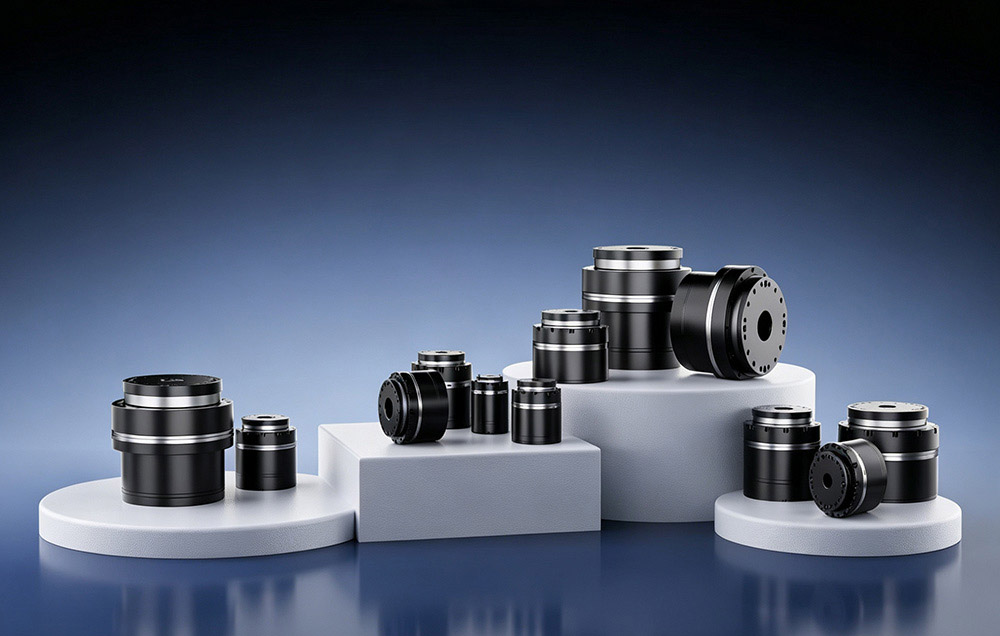
 A joint module is an integrated actuator. A strain wave gear set, a permanent magnet servo motor, an absolute encoder and a drive stage share one housing, and the unit terminates in a cross roller bearing output. One ambient condition therefore acts on the gear, the motor and the electronics at once.
The environmental envelope of an IP67 joint module is the range of ambient conditions under which its published ratings remain valid. Those ratings cover rated torque at the rated input speed, the backlash class of the series, a positioning accuracy of ±15 arc seconds and a design life of 10,000 to 15,000 hours. Outside that envelope the figures become undefined. Torque capacity, grease behavior and encoder stability are no longer described by the catalog.
This article compares the two ends of the duty spectrum that most often force a platform decision: semiconductor cleanroom duty and machine tool washdown duty. Sealing, lubrication, surface treatment and electrical design are treated as the four subsystems that set the boundary, and they govern a family of joint modules expected to serve more than one industry.
Working Principle: How the Environment Reaches the Drive Train
Torque is transmitted through elastic deformation of a thin walled flexspline. An elliptical wave generator engages that flexspline with a rigid circular spline, a mechanism set out in how strain wave gears work. Only a fraction of the teeth mesh at any instant, so flank contact stress is high and the lubricating film is thin by design. Anything that displaces grease from the contact, water, cutting fluid or metal fines, alters the stress state at the flank. Sealing and lubrication therefore form one design argument.
Ingress reaches the drive train along four paths:
- the rotary seals at input and output, where a pressure difference across a lip can pump fluid inward.
- the cable entry and connector interfaces, which on a low voltage module with an integrated drive form the largest non metallic boundary of the enclosure.
- housing joints, cover fasteners and threaded interfaces that are not sealed during assembly.
- condensation, in which a falling ambient temperature draws moisture out of air trapped inside the enclosure.
A lip seal that pumps fluid emulsifies the grease and raises running torque before any loss of positioning appears. Condensation attacks bearing races and shifts backlash as the preload path is disturbed. The duty classes below run from cleanest to most severe.

| Duty class | Typical processes | Dominant stress | Primary measure |
|---|---|---|---|
| Clean environment | Wafer handling, panel assembly in semiconductor and 3C equipment | Particle and volatile emission | Low outgassing grease, cleanable finish |
| Indoor automation | Assembly, sorting, palletizing | Dust and oil mist | Sealed housing and connector interfaces |
| Machining cell | Cutting fluid spray, chip wash | Fluid and swarf ingress | IP67 sealing, emulsification resistant grease, black oxide |
| Washdown and rinse | Food processing, surface treatment | Spray, temporary immersion | IP67 sealing, sealed cable entry, corrosion protection |
| Outdoor and humid | Plant exposed to weather | Condensation, corrosion | Sealing against breathing, black oxide |
Sealing, Lubrication, Surface Treatment and Electrical Design
Sealing and the Ingress Boundary
Sealing defines the boundary. Seal and groove geometry is specified per family (FHT-I, FHT-II and FHT-V). Assembly requires sealing at the input fixed end and the output side, with a defined grease fill of the flexspline cavity.
Grease Selection by Duty Class
Lubrication defines behavior inside that boundary. Cleanroom duty calls for low particle emission and a low volatile fraction, because whatever leaves the grease contaminates a wafer or a panel. Washdown duty calls for a grease that resists emulsification with cutting fluid and holds consistency across the cell’s temperature range. Both duties load the same tooth flanks. A change of grease therefore changes torque capacity and running temperature.
Black Oxide on Exposed Surfaces
Surface treatment defines the outer face. Black oxide is an oxidation process that forms a dense oxide film on ferrous surfaces and raises resistance to rust. Laifual Drive applies it to the T type joints in its joint module range and to selected precision bearings. On those parts it slows localized corrosion and holds an oil film better than a bare machined surface.
Encoder Retention and Motor Insulation
Electrical design defines what sits inside. An absolute encoder that retains shaft position and multi-turn count through a power interruption makes a restart after washdown deterministic. F class insulation rated to 155 °C sets the sealed motor’s thermal headroom.
| Subsystem | Cleanroom requirement | Washdown requirement |
|---|---|---|
| Sealing | Seals that do not shed particles or volatiles | IP67 boundary at seals, cable entry and connectors |
| Lubrication | Low emission grease with stable consistency | Grease that resists emulsification with cutting fluid |
| Surface treatment | Cleanable finish with no loose coating | Black oxide film for resistance to rust |
| Electrical | Encoder feedback without intermittent faults | Sealed connector interface, multi-turn retention |
Parameter Definitions and Design Criteria
IP67 is two digits: the first, 6, means dust-tight. The second, 7, means protection against the effects of temporary immersion in water under defined test conditions. Neither digit states spray duration, fluid compatibility, or particle emission into a clean space. Those properties still decide whether one module serves either end of the spectrum.
Rated torque is the permissible continuous load torque at a rated input speed of 2000 r/min, and backlash is quoted by series as 60, 30 or 20 arc seconds or less. Positioning accuracy is ±15 arc seconds and design life is 10,000 to 15,000 hours, assuming the module runs inside its specified environment and grease remains at the tooth contact. Holding that accuracy across a long duty cycle also depends on how the gear set handles excitation at the mesh, the subject of vibration control in harmonic reducers.
Average load torque Tav must not exceed the permissible average load torque of the selected size. Ni av and Ni max are each checked against their limits. For unit type modules with an integrated cross roller bearing, the maximum moment load, bearing life and static safety factor are checked as a second set of criteria.
The delta tooth profile raises load capacity by 15% to 30% over the conventional double circular arc profile and lowers temperature rise by 8 to 10 °C, which extends grease life.
| Parameter | Value | Basis |
|---|---|---|
| Rated torque | catalog value per size | Permissible continuous load torque at 2000 r/min input |
| Backlash | 60, 30 or 20 arc seconds or less | Specified by series, referred to the output |
| Positioning accuracy | ±15 arc seconds | Output accuracy of the module |
| Design life | 10,000 to 15,000 hours | Rated service life under specified conditions |
| Ingress protection | IP67 | Dust-tight, protected against temporary immersion |
| Communication | BiSS-C, TAMAGAWA, CANopen, CAN FD, EtherCAT, Modbus | Encoder and fieldbus protocols; -C and -E low voltage versions |
What the IP67 Rating Means for a Joint Module
Ingress protection is a precondition for the performance claims that follow. An IP67 joint module admits no dust and survives temporary immersion, which makes the same hardware usable in a machining cell and at a rinse station. The code says nothing about a cleanroom, where the requirement reverses: the risk is that the module releases material into the clean space, not that the environment enters it.
In a cleanroom, grease, seals and cable jackets are judged by what they emit over thousands of hours of slow motion, and a finish by whether it can be wiped clean. In a machining cell the same items are judged by what they keep out: cutting fluid under pressure, chip wash and metal fines. A module that serves both must satisfy an emission and an exclusion criterion at once. That dual criterion is routine in medical device production, where harmonic drives in medical technology have to stay clean and stay accurate at the same time.
Technical Data
The range covers outside diameters from 40 mm to 190 mm without a gap, so one platform scales from a small collaborative axis to a large industrial axis. An IP67 joint module carries the same mechanical interface for either duty. The environmental decisions are then held in the seal variant, the grease and the surface treatment.
| Item | Coverage |
|---|---|
| Joint module outside diameter | 40 mm to 190 mm, continuous covering the current low- and high-voltage product range |
| DC low voltage platform | 48 V DC, integrated servo drive; L40I, L52I, L60I, L70I, L80I, L90I, L110I, L142I, L170I, L190I |
| AC high voltage platform | 220 V AC, large hollow shaft; M70, M80D, M90D, M110D, M142D, M170D, M190 |
| Robot arm payload classes | 3 kg to 20 kg |
| Size correspondence | 40 mm corresponds to about size 8, 190 mm to about size 45 |
| Harmonic reducer sizes | Size 3 to size 58, ratios 30:1 to 160:1, outside diameter 13 mm to 246 mm |
| Lightweight series | FSN, about 30% lower mass at the same rated torque, stiffness and transmission accuracy |
Laifual Drive produces the flexspline, the circular spline and the cross roller bearing in house, with a flexspline self supply rate above 80% in 2025. Cumulative shipments of harmonic reducers have passed one million units.
For machines outside the standard product range, a custom design service covers modified sealing, surface treatment and interface geometry.
Selection and Design Procedure
- Define the duty class for each axis and record the fluids, cleaning agents and temperature range it will actually see.
- Compute the load cycle and derive the average load torque Tav. Select a size whose permissible average load torque is at least Tav, using values defined at 2000 r/min input.
- Check average input speed Ni av and maximum input speed Ni max against the limits for the selected size and ratio.
- For unit type modules with an integrated cross roller bearing, verify maximum moment load, bearing life and static safety factor at the mounting interface.
- Select the backlash class for the axis accuracy the process requires.
- Choose the sealing variant (FHT-I, FHT-II or FHT-V) that matches the protection level, and confirm that assembly covers the input fixed end, the output side and the grease fill.
- Fix the grease against the cleanroom emission criterion or the washdown emulsification criterion, then recheck the thermal margin.
- Specify the applicable surface treatment for exposed parts, confirm the motor insulation class, and select the appropriate communication protocol: CANopen, CAN FD, EtherCAT or Modbus for the 48 V DC low-voltage series, and BiSS-C or TAMAGAWA for the 220 V AC high-voltage series.
Application Notes
Fluid collects at horizontal joints, so in a washdown or humid cell mount the module so runoff does not pool against a seal lip. Fasteners that pass through the housing wall should be sealed on assembly. The cable route should also carry a drip loop below the connector.
Grease service intervals should follow the duty class rather than the calendar. Cleanroom modules may run for years on one fill. A machining cell module can emulsify its grease if a seal lip is damaged by swarf, raising running torque and temperature before any loss of positioning appears. A rise in running temperature at constant duty points to the seals, not to cooling.
Black oxide film depends on an oil or grease film for full effect, so wiping it with solvent and leaving it dry removes part of the protection. Condensation also matters: a module that stops warm in a humid plant can pull moisture through breathing paths onto bearing races and the encoder. The enclosure should therefore be closed at every interface, and multi-turn retention lets the controller recover position without a homing cycle after a maintenance stop.
Design Consequences for Cleanroom and Washdown Axes
A joint module is defined by more than its torque curve and backlash figure. Sealing, lubrication, surface treatment and electrical design all have to hold their specified performance in the environment where the module is installed.
Cleanroom and washdown duty stress those four subsystems in opposite directions. One duty works by emission and one by exclusion. One IP67 platform covers 40 mm to 190 mm on both the 48 V DC and 220 V AC ranges. The duty class should therefore be recorded for each axis before the seal variant, the grease and the surface treatment are fixed.
Matching those three items to the recorded duty keeps the published figures valid for the life of the machine. Those figures are rated torque at 2000 r/min input and a positioning accuracy of ±15 arc seconds. Design life is 10,000 to 15,000 hours. Backlash classes run from 60 to 20 arc seconds or less, quoted by series.