
From Miniature to Heavy-Duty: Laifual Drive’s Harmonic Reducer Portfolio
Explore how Laifual Drive bridges precision miniature harmonic reducers (size 3) to heavy-duty actuators (size 58), detailing engineering capabilities and sizing.
 October 09, 2026
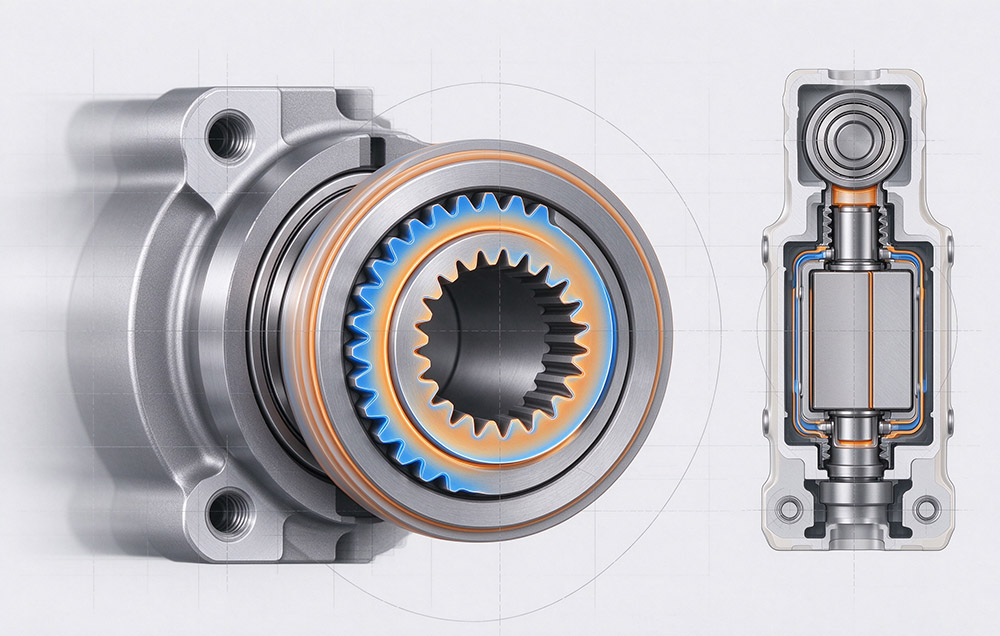
 > From Miniature to Heavy-Duty: Laifual Drive’s Harmonic Reducer Portfolio
A miniature harmonic reducer, also called a strain wave gear, uses a compact flexspline to fit applications with limited installation space. At the heavy-duty end of the range, the engineering priorities shift toward structural design, large-part machining, and consistency across components. Miniature designs demand tight control of tooth profile and assembly tolerances; larger designs require careful management of thermal distortion, assembly stress, and material uniformity.
Laifual Drive’s harmonic reducer portfolio spans reducer sizes 3 to 58, outside diameters from 13 mm to 246 mm, and reduction ratios from 30:1 to 160:1. Laifual Drive rotary joint modules cover outside diameters from 40 mm to 190 mm. This article explains the different manufacturing challenges at the miniature and heavy-duty ends, and the process capabilities needed to support a broad product range.
A supplier experienced only with miniature reducers may have difficulty scaling up to large frames, while a supplier focused on large reducers may not have the process control required for compact designs. Broad size coverage depends on maintaining both capabilities and validating each product against its own specifications.
| Aspect | Miniature End | Heavy-Duty End |
|---|---|---|
| Capability under test | Tooth-profile machining and assembly tolerance at small scale | Structural design, large-part machining, and component consistency |
| Size context | Compact flexspline and limited installation space | Reducer outside diameter up to 246 mm; joint modules up to 190 mm outside diameter |
| Main process risks | Tooth-profile tolerance, coaxiality, and grease quantity | Thermal distortion, assembly stress, and material uniformity |
| Typical applications / equipment | Dental milling machines, precision rotary tables, and dexterous robotic joints | CNC fourth- and fifth-axis rotary tables, heavy-duty rotary axes, and automated equipment |
Mechanical Accuracy at the Miniature End
Tolerance at the Micrometer Scale
At the miniature end, the flexspline wall may be around one millimeter thick or less, depending on the design. Tooth-profile accuracy, assembly coaxiality, and grease quantity require careful process control. Deviations can affect transmission performance and repeatability, particularly where the reducer must fit into a compact mechanism. Miniature harmonic reducers are used in applications such as dental milling machines, precision rotary tables, and dexterous robotic joints, subject to the requirements of the specific model. Explore our Mini series.
Gear Cutting and Profile Accuracy
Gear cutting is a key contributor to tooth-profile accuracy. Laifual Drive uses an in-house developed gear-cutting process; the company reports that machining time for core components has been reduced from two to three hours to under 15 minutes. Actual process time depends on the component and production route, while finished-part quality must be verified against the applicable drawing and inspection criteria via advanced precision gear shaping technology.
Tooth Form and Capacity in a Fixed Section
Tooth profile influences load distribution and transmission performance. Laifual Drive’s δ tooth profile is designed as an alternative to the conventional double-circular-arc profile. Any quantified improvement in load capacity, temperature rise, pitting resistance, or service life should be stated only where supported by a validated comparison for the specific reducer series and test conditions. In a miniature drive, the available installation envelope limits the space for the gear stage, making profile design one of several factors in the overall performance.
Weight and Joint Inertia
Weight is another consideration in compact robot joints. Laifual Drive’s FSN lightweight series is designed to reduce mass while maintaining the performance targets defined for that product family. The previously stated figure of approximately 30% weight reduction should be used only when the comparison baseline and model-specific data are confirmed. Lower joint mass can reduce the load on neighboring structures, so lightweight selection should be assessed at the system level. Learn more about how strain wave gears work.
Structural Consistency at the Heavy-Duty End
At the larger end of the portfolio, harmonic reducers are used in CNC fourth- and fifth-axis rotary tables, heavy-duty rotary axes, and automated equipment. Selection depends on the required torque, stiffness, accuracy, duty cycle, and installation envelope. For integrated rotary joint modules, the upper end of Laifual Drive’s published outside-diameter range is 190 mm; the harmonic reducer range itself extends to 246 mm outside diameter. Motor, encoder, and drive arrangements depend on the module configuration, following the harmonic reducer working principle.
Thermal behavior is an important design consideration for larger frames. Losses, duty cycle, lubrication, and heat dissipation all influence operating temperature. Class F motor insulation is commonly associated with a 155 °C thermal class, but the applicable rating should be confirmed against the specific motor and module documentation. Surface treatments, including black oxide on selected T-type joints or precision bearings, may improve corrosion resistance where specified; they should not be treated as a substitute for a model’s environmental rating.
Consistency across large parts is another manufacturing challenge. Producing one large flexspline does not by itself demonstrate repeatability across a production batch; wall thickness, roundness, and tooth profile must remain within the relevant tolerances. Laifual Drive reports in-house production of flexsplines, circular splines, and cross-roller bearings, with flexspline self-supply above 80% in 2025. Its heat-treatment capabilities include quenching, tempering, austempering, and vacuum treatment.
Assembly and sealing requirements vary by product family and configuration. Seal locations and oil-seal or groove dimensions should be checked against the applicable model drawing. Laifual Drive’s joint module portfolio includes low-voltage 48 V DC and high-voltage 220 V AC families, with different control and feedback options. The low-voltage family supports CANopen, CAN FD, EtherCAT, and Modbus according to model/configuration; the high-voltage family uses BiSS-C and TAMAGAWA encoder interfaces where specified. Confirm IP protection, insulation class, encoder behavior, and dual-loop control support at the model level rather than assuming these features apply to every module.
What a Continuous Portfolio Requires
Building the two ends is the easier part; filling the space between them is the harder one. Middle sizes carry the highest shipment volume, the widest variation in custom requirements, and the heaviest dependence on process stability. A continuous ladder therefore says as much about production engineering as about catalog discipline. Full coverage means a product at every step, with performance curves that join rather than jump between steps.
Laifual Drive’s strain wave gear portfolio spans sizes 3 to 58 and includes the FSS, FSF, FSN, FSG, FHT cup and hat, FHG, FHD, FHN, FBS-U, FBS-C, and Mini families. The rotary joint module range covers outside diameters from 40 mm to 190 mm. The available sizes and interfaces should be checked against the relevant product drawings and configuration data; a shared supplier does not automatically mean that all models use identical mounting or electrical interfaces. Browse our comprehensive strain wave gear series.
Laifual Drive’s manufacturing capabilities include dedicated steel melting and forging processes, in-house heat treatment, and internal production of flexsplines, circular splines, and cross-roller bearings. The company also reports dedicated fatigue testing, a production site covering 52,000 square meters, a research and development team of more than 100 people, and cumulative deliveries of one million harmonic reducers. Research collaboration platforms include Chongqing University, Zhejiang University of Technology, and Huazhong University of Science and Technology.
Where a standard product does not meet the application requirements, Laifual Drive offers a non-standard design route. The stated planning cycle is about two weeks for a proposal and about four weeks for samples, subject to project scope and confirmation. The joint module portfolio includes 48 V DC low-voltage models and 220 V AC high-voltage models; available sizes, drive integration, shaft configuration, brake options, feedback interfaces, and communication protocols vary by model. Payload suitability must be assessed from the application load case and the relevant module ratings. View all available joint modules.
| Published Coverage | Value |
|---|---|
| Harmonic reducer sizes | Size 3 to size 58 |
| Reduction ratio | 30:1 to 160:1 |
| Reducer outside diameter | 13 mm to 246 mm |
| Joint module outside diameter | 40 mm to 190 mm across the range |
| Module size correspondence | Approximate correspondence is model-dependent; confirm using current product drawings |
| Payload classes | Application- and model-dependent; verify against the module ratings |
| Reducer families | FSS, FSF, FSN, FSG, FHT cup and hat, FHG, FHD, FHN, FBS-U, FBS-C, and Mini |
Rating Data Across the Range
For selection, compare rated torque using the catalog’s defined input speed and check the duty cycle, average and maximum input speeds, external loads, and bearing limits where applicable. Backlash grades and service-life figures vary by reducer series, model, and operating conditions. Do not apply a single positioning-accuracy figure, backlash grade, or 10,000–15,000-hour life target to the entire portfolio unless the current model-level documentation confirms it.
| Parameter | Definition or Value |
|---|---|
| Rated torque | Use the catalog definition and rated input speed for the selected model |
| Average load torque Tav | Compare duty-cycle average torque with the model’s permissible average load torque |
| Speed checks | Average input speed Ni av and maximum input speed Ni max |
| Bearing checks for integrated units | Check maximum moment load, bearing life, and static safety factor where specified |
| Positioning accuracy | Model- and configuration-specific; verify the current product specification |
| Backlash by series | Varies by reducer series; verify the selected model’s catalog data |
| Design life | Depends on load spectrum, speed, lubrication, and operating conditions |
| δ tooth profile | Performance differences versus other tooth profiles require model-specific validated data |
Specifying Across the Full Range
The same selection method can be used across the range, from compact harmonic reducers with 13 mm outside diameter to larger reducers up to 246 mm. Integrated joint modules are a separate product category and cover 40 mm to 190 mm outside diameter.
-
1Read the available envelope and the mounting interface from the released drawing, and note whether the space suits a compact harmonic reducer in a Mini frame or a large integrated module.
-
2Derive Tav from the torque and speed profile of the cycle, including the acceleration segments that dominate short moves.
-
3Compare Tav with the permissible average load torque of the intended frame at the intended ratio, both defined at 2,000 rpm input.
-
4Check Ni av against the duty cycle and Ni max against the peak move.
-
5Select the backlash grade from the specification for the chosen reducer series, then verify that the model’s documented accuracy and repeatability meet the axis requirement.
-
6For integrated joint modules with a built-in cross-roller bearing, check the model’s maximum permissible moment load, bearing life, and static safety factor alongside the torque rating.
-
7Confirm the electrical and mechanical configuration: 48 V DC or 220 V AC family, shaft and mounting arrangement, brake requirement, drive integration, encoder interface, and supported communication protocol. Do not assume that -C or -E suffixes or their protocol assignments apply across every model.
-
8Step up one frame only when a criterion fails, since a larger frame adds mass, inertia, and current demand that the surrounding structure has to carry.
This range supports different design needs, from a compact collaborative-robot wrist axis to a larger rotary table or industrial axis. Selection should use the same disciplined process—installation envelope, duty cycle, speed limits, torque, and bearing checks—while relying on the specifications for the selected product. Laifual Drive’s harmonic reducers span sizes 3 to 58 and outside diameters from 13 mm to 246 mm; its rotary joint modules cover 40 mm to 190 mm outside diameter.
For engineers sourcing miniature and heavy-duty harmonic reducers, the practical benefit of a broad portfolio is the ability to compare options within one supplier’s product range. Final selection should still be based on model-specific drawings, ratings, interfaces, and validated application data. Contact our engineering team for custom selection support.