July 22, 2026
Tesla’s Optimus humanoid robot program has provided the engineering community with an unusual degree of transparency into the actuator architecture of a commercial humanoid robot in development.
Through presentations at Tesla AI Day events, the company has shared details about the actuator types, joint configurations, and design philosophy behind Optimus. For engineers working on robotic actuation systems, these disclosures offer valuable reference points.
The Optimus Actuator Architecture
Tesla has described Optimus as using an all-electric actuation system with approximately 28 structural actuators plus additional actuators in the hands. The rotary actuators employ a configuration that integrates a motor, a precision gear reducer, an encoder for position feedback, and a custom driver board.
This integrated approach mirrors the joint module concept Laifual has developed, where the reducer, motor, and electronics are pre-assembled and calibrated as a unit.
Design Choices That Matter
Tesla’s actuator design highlights several engineering decisions that are broadly applicable to humanoid robot development:
First, torque density is prioritized over all other mechanical metrics. The actuators must fit within anthropomorphic proportions while delivering sufficient torque for dynamic movements.
Second, backdrivability and transparency are engineered into the transmission. The robot must sense external forces through the drivetrain to enable compliant interaction. At least partial backdrivability is a design requirement, not an afterthought.
Third, thermal management is integrated into the mechanical design. Continuous operation generates heat in both the motor windings and the reducer’s oil film. The actuator housing serves as a heat sink, and its design must balance thermal performance with weight constraints.
Implications for Reducer Selection
The Optimus architecture validates several trends that component suppliers have already been addressing. The move toward integrated joint modules, where the reducer is not a standalone component but part of a calibrated actuator assembly, means that harmonic reducer manufacturers must offer more than just reducer components. They need to provide integration support, custom mounting interfaces, and joint-level testing data.
The voltage architecture choice, AC high voltage versus DC low voltage, is another area where the Optimus design provides a reference. Tesla’s approach informs the broader industry debate about optimal power architecture for humanoid robots.
Laifual’s dual product lines for both AC high voltage (M80D to M170D) and DC low voltage (L70I to L170I) joint modules mean the company can serve platforms regardless of which voltage architecture they adopt.
From Automotive to Humanoid: Tesla’s Manufacturing Approach
Tesla’s entry into humanoid robotics brings automotive-scale manufacturing thinking to a field that has historically been dominated by low-volume, high-cost production methods.
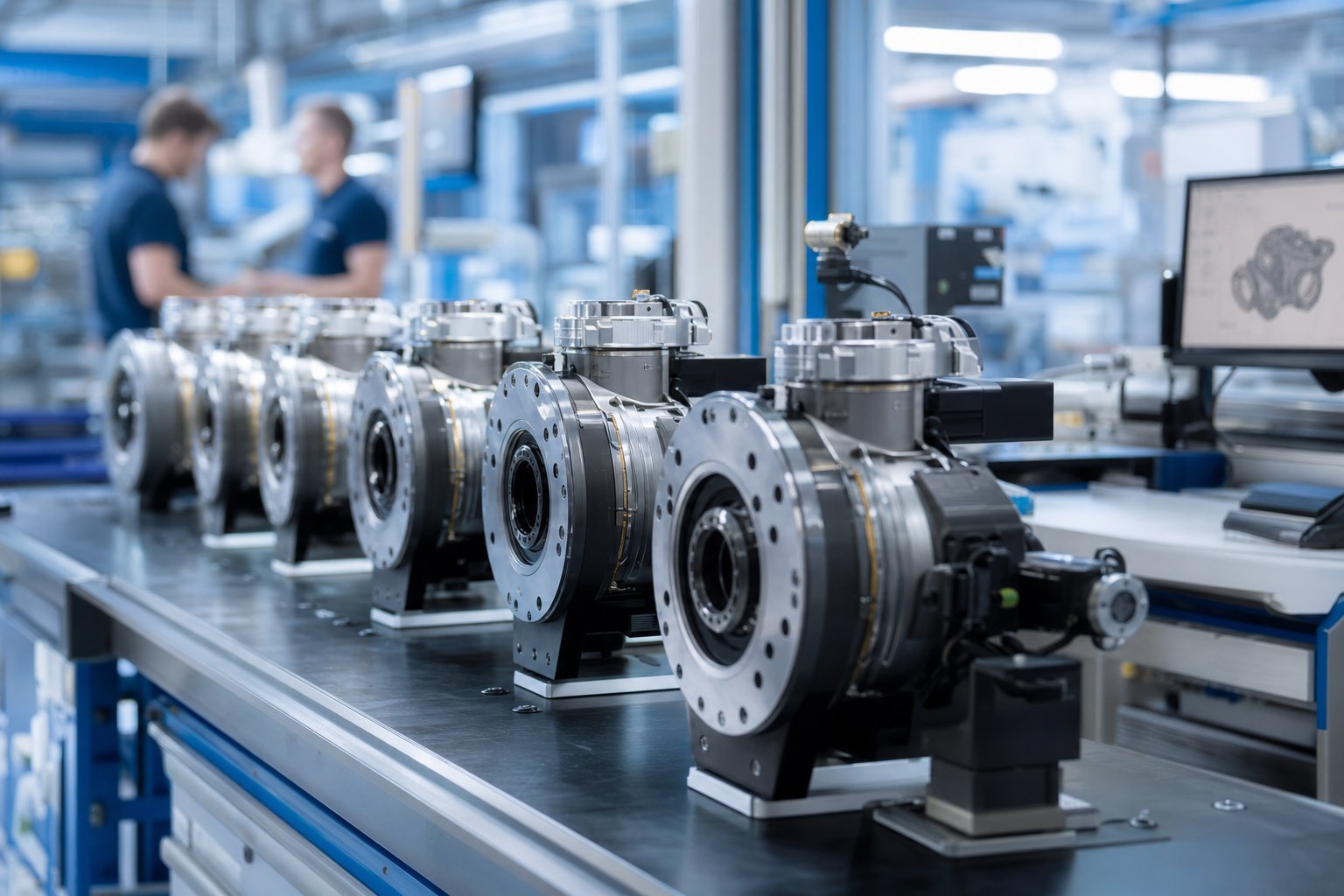
The company has publicly stated its intention to apply lessons from vehicle manufacturing, including vertical integration, automated assembly lines, and design-for-manufacturability principles, to Optimus production. This approach has direct implications for component suppliers.
For harmonic reducer manufacturers, serving a customer with automotive-scale ambitions means meeting requirements that go beyond product specifications. Production capacity must scale to support tens of thousands of units annually.
Quality consistency must achieve automotive-grade process capability indices. Delivery reliability must support just-in-time manufacturing schedules.
And cost targets must reflect volume economics rather than prototype pricing. These requirements favor suppliers that have already invested in full-chain production and high-volume manufacturing processes.
Customization Versus Standardization
One of the unresolved questions in the humanoid robot industry is the degree to which actuator designs will standardize across platforms versus remain customized to each OEM’s specific architecture. Tesla has developed Optimus actuators to its own specifications, as have other robot developers.
If the industry converges on a small number of standard actuator form factors, component manufacturers can achieve higher volumes of fewer SKUs, driving down costs. If customization remains the norm, manufacturers must maintain broader product lines with smaller batch sizes.
Looking Forward
The humanoid robot industry is still in its early stages. Actuator architectures that prevail in commercial products may differ from today’s prototypes. What will not change is the fundamental need for precision, reliability, and cost-effectiveness in mechanical transmission.
The harmonic reducer, from discrete components to integrated modules, addresses this need in a way no competing technology has matched. Companies that master its production will shape the physical foundation of the robot age.
Laifual offers both discrete harmonic reducers and pre-integrated joint modules. Visit our custom service to discuss custom actuator solutions for your robot platform.