
Where Planetary Gearboxes Fit Alongside Harmonic Reducers
Compare planetary gearboxes and harmonic reducers. Learn how to balance high gear ratios, torsional stiffness, backlash, and dual-stage drivetrain stacking.
 September 09, 2026
 > Where Planetary Gearboxes Fit Alongside Harmonic Reducers
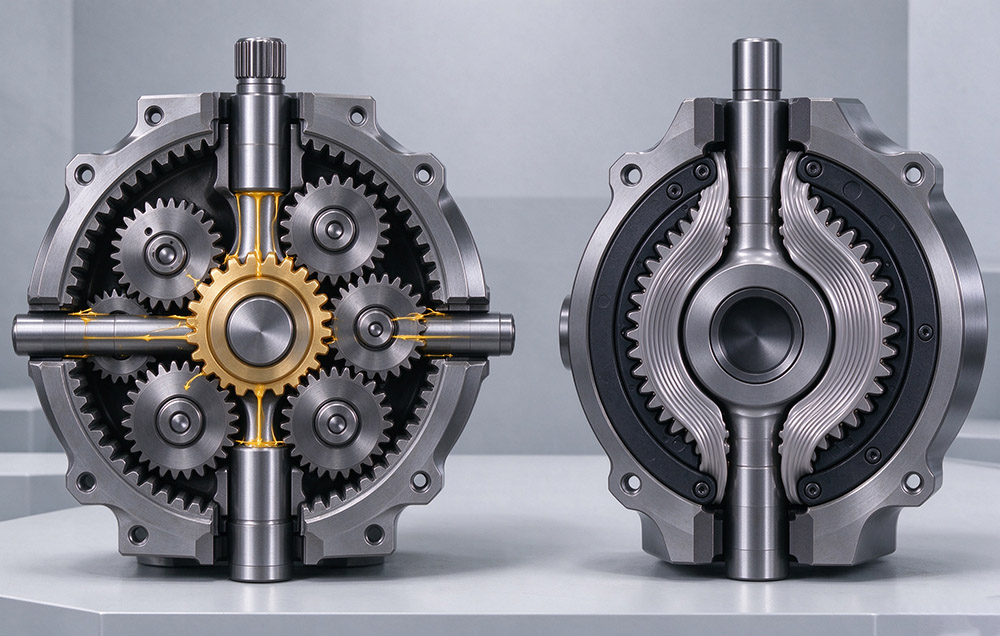
A planetary gearbox is a coaxial reduction stage: a sun gear drives several planet gears that mesh with a ring gear, and a carrier collects their motion. That load is shared across parallel tooth contacts. It answers the same question a strain wave gear answers: how to cut motor speed and raise output torque without losing control of position, but through different geometry. Laifual Drive builds both lines, which makes the comparison a design decision instead of a reason to change supplier.
No single transmission form covers every duty. A harmonic reducer carries a high reduction in one stage through the elastic deformation of a flexspline, which keeps it compact and low in backlash within a short axial envelope. The planetary gearbox develops torque through several planet gears sharing the load, which suits axes that call for stiffness and load capacity in a compact radial package. Machines that need both a high reduction and high output stiffness stack the two forms.
Role of Planetary Stages in Precision Motion
How a Planetary Stage Shares Its Load
Torque passes through a sun gear, a set of planet gears on a carrier, and a ring gear that closes the loop. Because several planet gears mesh at once between the sun and the ring, tooth load is shared and the reaction forces on the shaft largely balance. That geometry sets its character: high torque density for its size, good torsional stiffness, and a reduction per stage that is modest beside the single-stage ratio of a strain wave gear.
How a Strain Wave Stage Builds Its Ratio
This strain wave gear works on a different principle. A wave generator deflects a thin-walled flexspline into the circular spline, and the two-tooth difference produces a large reduction without stacking stages, giving a compact, light reducer with low backlash and low lost motion. Its trade-off is a rating structure built around the flexspline and the cross-roller bearing, not around rolling contact between rigid gears.
What the Distinction Means at Drive Train Level
That distinction matters at drive train level. Often the planetary gearbox is inserted to multiply torque ahead of a final positioning stage, or on an axis whose ratio demand is modest while load and stiffness demands are high. It takes the axis that must hold position accurately in the smallest possible envelope. Together the two cover more joints than either covers alone, and the harmonic planetary gearbox guide works through that comparison.
Trade-Off Axes Between the Two Forms
This comparison sets out axes on which the two forms weight the same requirements differently, and a design settles on one by deciding which axes have room.
| Design Axis | Planetary Stage | Strain Wave Stage |
|---|---|---|
| Reduction per stage | Modest; a high ratio needs more stages or a larger frame | High in a single pair, from 30:1 to 160:1 across the Laifual Drive range |
| Load sharing | Several planet gears mesh at once, which spreads tooth load | One flexspline engagement per position, with capacity set by the tooth profile and wall section |
| Torsional stiffness | High, and easy to raise with frame size or stage count | Load dependent, since the flexspline and bearing deflect under torque |
| Backlash and lost motion | Set by gear clearances and by stage count | Backlash graded by series at ≤60, ≤30, or ≤20 arcseconds, with lost motion larger than backlash |
| Axial dimension | Grows as stages are stacked to reach a high ratio | Short at high ratio, because one flexspline pair does the work |
| Weight | Carried by rigid gears and a heavy carrier | A lightweight harmonic family is about 30 percent lighter at the same rated torque, stiffness, and accuracy |
| Natural role | High load, high stiffness, moderate ratio | Compact, precise, space-sensitive axis |
Two units of the same rated torque do not behave alike if one holds torque through rolling contact and the other through an elastically deflected cup, which is why the comparison stays qualitative here. The high precision planetary gearboxes overview covers the planetary side of that comparison in its own terms.
Ratio demand is the first filter. Where a single stage of 30:1 or more is needed at the joint, a harmonic reducer does the whole job in one short unit. Matching it with a planetary gearbox would take two or three stages and a longer body. Where the axis needs roughly the ratio one planetary stage provides, the planetary unit is the simpler transmission and brings stiffness with it.
Stiffness and accuracy pull in a different direction. The strain wave stage has a torsional stiffness that changes with load, so its wind-up under torque belongs in the position error budget unless the control loop compensates for it. A planetary stage holds a flatter stiffness curve, which helps an axis resist a disturbance torque. This strain wave gear series spans size 3 to size 58, outside diameters of 13 mm to 246 mm, and ratios of 30:1 to 160:1. That range makes the harmonic side of a drive train available across the full frame range, and a planetary stage is chosen against it instead of in place of it.
Where a Planetary Stage Belongs in the Drive Train
Position in the train changes how much a stage’s error is worth. In a two-stage arrangement, the backlash of the input stage is divided by the ratio of the downstream stage before it reaches the load. An upstream stage therefore contributes far less position error than the same stage at the output.
At the fast end, the torque is low and the speed is high, which is where a planetary stage can multiply torque before a compact, accurate stage takes over the final reduction. At the slow end, the harmonic reducer holds the position the machine measures, so its backlash grade of ≤60, ≤30, or ≤20 arcseconds sets the accuracy class of the axis. On an integrated axis, the positioning accuracy is ±15 arcseconds.
That order reverses when the duty demands it, since an axis that must resist a large moment load benefits from a stiff planetary output. That decision comes from the duty cycle, and how to choose the right gear reducer sets out the surrounding method.
Combining Both Forms in One Axis
A Stacked Train for High Ratio with High Stiffness
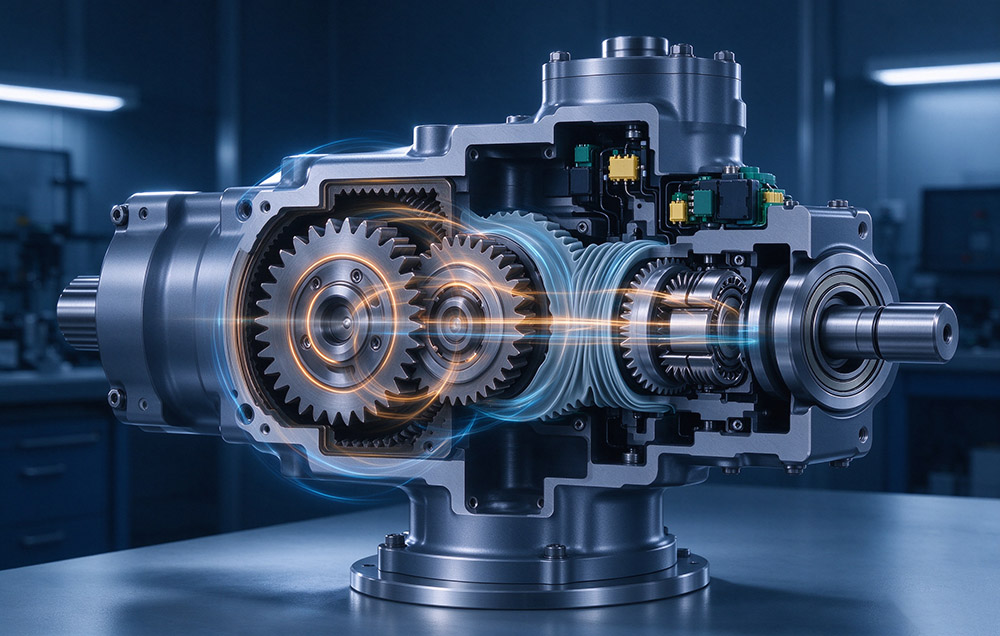
A stacked train is chosen when one form cannot meet every requirement at once. The classic case is a high ratio with high stiffness and high torque. Here a planetary gearbox supplies the torque multiplication and the stiffness, and a harmonic reducer supplies the final precise, compact reduction. The joint module line wraps this idea into one housing. An integrated actuator carries the reducer, the motor, the encoder, and the drive in a single envelope from 40 mm to 190 mm outside diameter.
What Series Arrangements Lend to the Stack
Series arrangements also carry a cost that is easy to miss. Every added stage contributes inertia, wind-up, and a tolerance stack, and each interface is a place where a mounting error becomes an alignment error. One housing removes couplings between stages, fixes the bearing arrangement, and seals the assembly to IP67. That is the logic an OEM applies when it treats a joint module as one catalog item instead of three components to marry on the bench.
Reading a Planetary Gearbox Datasheet Against a Harmonic Datasheet
Both datasheets use overlapping terms with different definitions, and a comparison that ignores this produces the wrong frame. Rated torque is the permissible continuous load torque at an input speed of 2,000 rpm in the Laifual Drive catalogs. Any torque figure quoted without its input speed cannot be read across documents.
| Parameter | What It Fixes | Note When Comparing |
|---|---|---|
| Rated torque | The continuous load a frame permits at a stated input speed | Read at 2,000 rpm input |
| Permissible average load torque | The duty average the frame will carry | Compared against Tav from the duty cycle |
| Backlash | Geometric play at the output with the input held | Graded by series at ≤60, ≤30, or ≤20 arcseconds |
| Lost motion and hysteresis | Play plus elastic deflection | Larger than backlash, and the figure that matters in reversal |
| Torsional stiffness | Wind-up per unit torque | Load dependent in a strain wave stage |
| Design life | Rating life in hours | 10,000 to 15,000 hours, with the achieved figure set by the load spectrum |
| Moment capacity | Bending the output bearing will carry | Checked for unit type designs with a built-in cross-roller bearing |
Two consequences follow. Planetary and harmonic units of equal rated torque cannot be swapped, because the duty that reaches the rating is judged on the average, not on the peak. The bearing side is rated separately as well, so a unit-type design needs its maximum moment load, bearing life, and static safety factor checked in addition to the gear rating.
Selection Sequence for a Mixed Transmission Chain
01
Read the envelope first: available length, outside diameter, mounting interface, and any hollow shaft requirement.
02
Fix the ratio at the joint, and split it only where one form cannot carry it at the required frame size.
03
Compute Tav from the torque and speed profile of the axis over the full cycle.
04
Compare Tav against the permissible average load torque of each candidate at its intended ratio, defined at 2,000 rpm input.
05
Check Ni av against the duty and Ni max against the peak move, separately.
06
Set the accuracy class from the backlash grade, and confirm that lost motion and hysteresis fit the reversing duty.
07
For unit-type designs, verify maximum moment load, bearing life, and static safety factor.
08
Place each stage by its error contribution, so a stage with looser backlash sits upstream of the ratio that divides it.
Supply Consistency Across Two Transmission Lines
Mixed drive trains are easier to specify when both forms come from one supplier. Laifual Drive produces the flexspline, the circular spline, and the cross-roller bearing in-house, and extends that base to the FB series. There the tooth profile is matched to the radial displacement of the generator, so backlash can be adjusted to the application.
Behind both lines, the manufacturing base is one chain. Flexspline steel is melted and forged on dedicated lines with self-supply above 80 percent in 2025, and heat treatment covers quenching, tempering, austempering, and vacuum treatment. Skiving developed in-house cut core part machining time from two to three hours to under 15 minutes. The site covers 52,000 square meters with more than 100 engineers in research and development, and cumulative delivery stands at one million harmonic reducers.
When to Choose Planetary or Harmonic
Choose a harmonic reducer when the axis must hold position accurately in the smallest envelope, as in wrist and elbow joints. It also fits any joint where the ratio demand is high and the backlash budget is tight. Backlash graded at ≤60, ≤30, or ≤20 arcseconds, ±15 arcsecond positioning accuracy, and a design life of 10,000 to 15,000 hours describe that class of axis in verified terms.
Choose a planetary gearbox when the axis needs stiffness and load capacity at a moderate ratio, or when a disturbance torque must be resisted, not followed. The planetary form also fits a high ratio built in stages, where the fast end can carry the torque multiplication. Where both demands appear in one joint, stack the two.
Key Drivetrain Takeaway
The decisive question is where the machine measures position. A stage placed upstream of a large reduction has its backlash divided before it reaches the load, and a stage placed at the output carries its full effect into the accuracy class of the axis. A team that keeps that ordering in view can use a planetary gearbox and a strain wave gear in the same machine without trading accuracy for torque. It also avoids paying for a frame or a supplier it does not need.
Optimize Your Mixed-Stage Transmission Architecture
Speak with our drivetrain engineering team for custom gear-train simulations, ratio distribution calculations, and integrated actuator CAD models.